Corporate Duty of Care for Business Travel in Toronto: What Employers Are Legally Required to Provide
Corporate duty of care for business travel in Toronto is an employer’s legal obligation to protect employees from foreseeable health, safety, and security risks during work-related trips. In Ontario, this standard is grounded in common law negligence and Section 25(2)(h) of the Occupational Health and Safety Act (OHSA), requiring companies to take every reasonable precaution for worker protection whenever staff travel for business.
Table of Contents
What a Duty of Care Program Must Cover (5-Part Framework)
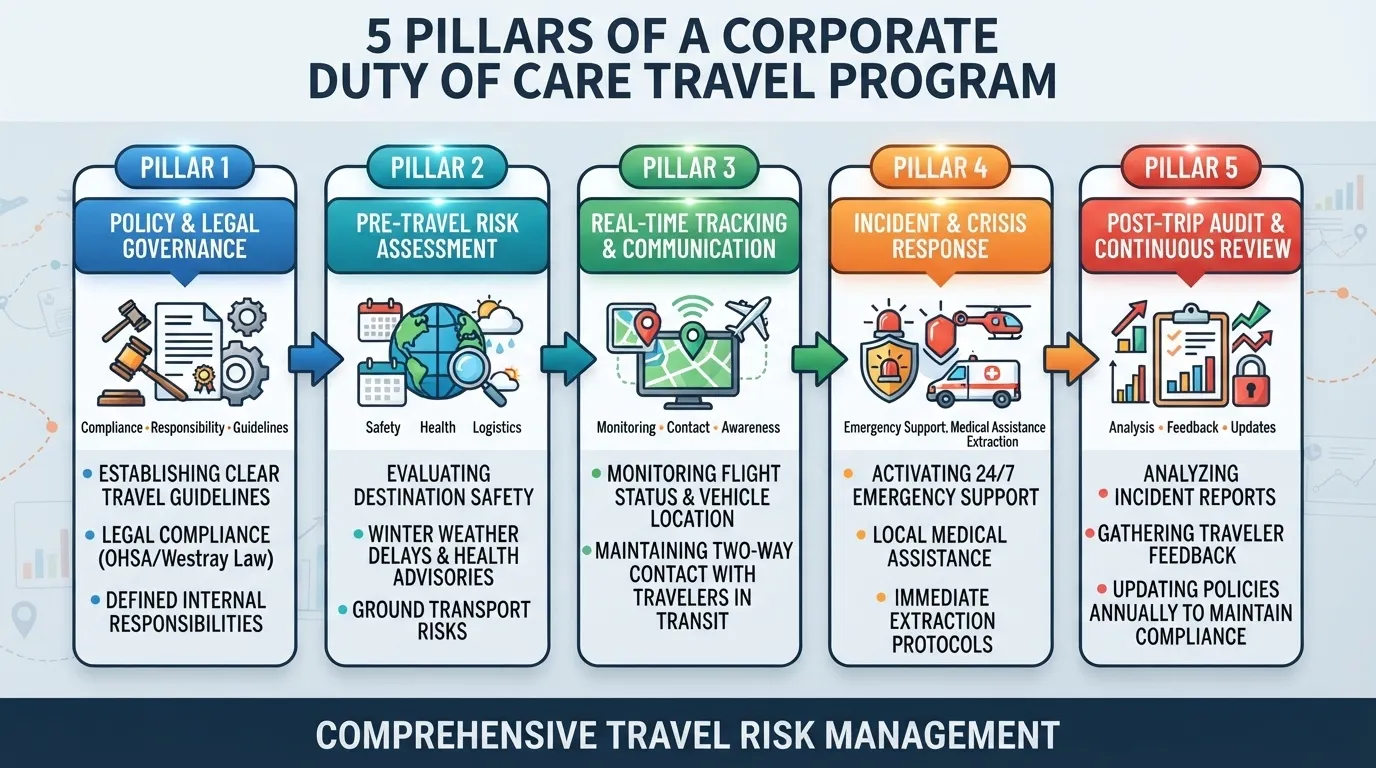
A comprehensive corporate duty of care program for Toronto-based organizations must address employee safety across five distinct operational phases, aligning with standards like ISO 31030 for travel risk management.
Travel Policy & Approved Vendors
Defines mandatory booking channels, pre-approved travel suppliers, and allowable expense thresholds.
Establishes clear boundaries for acceptable modes of transit and accommodation, reducing liability under the Ontario Occupational Health and Safety Act (OHSA).
Mandates that all employees opt into safety tracking and corporate communication tools prior to departure.
Pre-Trip Risk Assessment
Evaluates target destinations, transit corridors, and weather forecasts, particularly regarding seasonal GTA disruptions like lake-effect snowstorms or de-icing delays at Pearson International Airport (YYZ).
Identifies individual employee needs, health requirements, or specific safety concerns based on the travel itinerary.
Triggers formal authorization or additional mitigation steps for high-risk regions or complex cross-border trips (e.g., land travel to Buffalo or Detroit).
Real-Time Tracking & Communication During Travel
Maintains 24/7 visibility over employee locations through automated itinerary feeds or mobile check-in applications.
Provides immediate, two-way emergency communication channels to send location-specific alerts during severe weather, transit strikes, or security incidents.
Ensures a dedicated crisis management contact is reachable at all times to initiate emergency protocols or medical evacuation if necessary.
Ground Transportation & Booking Standards
Requires commercial transport providers to carry appropriate municipal licensing and commercial liability insurance policies.
Prioritizes vetted ground services that utilize professional, background-checked drivers, real-time flight tracking to adjust for YYZ/YTZ delays, and fixed-rate pricing to prevent unvetted on-demand hailed rides during surge events.
Eliminates reliance on unvetted street hails or unregulated rideshare drivers where identity verification, vehicle maintenance, and driver background checks cannot be independently confirmed.
Post-Trip Follow-Up
Collects immediate feedback regarding safety incidents, vendor non-compliance, or unexpected travel hazards encountered during the trip.
Audits travel data against the policy to address unauthorized bookings and update risk registers for future itineraries.
Formally closes out open travel files once the employee has returned home safely.
Toronto & GTA-Specific Risk Factors Employers Must Plan For
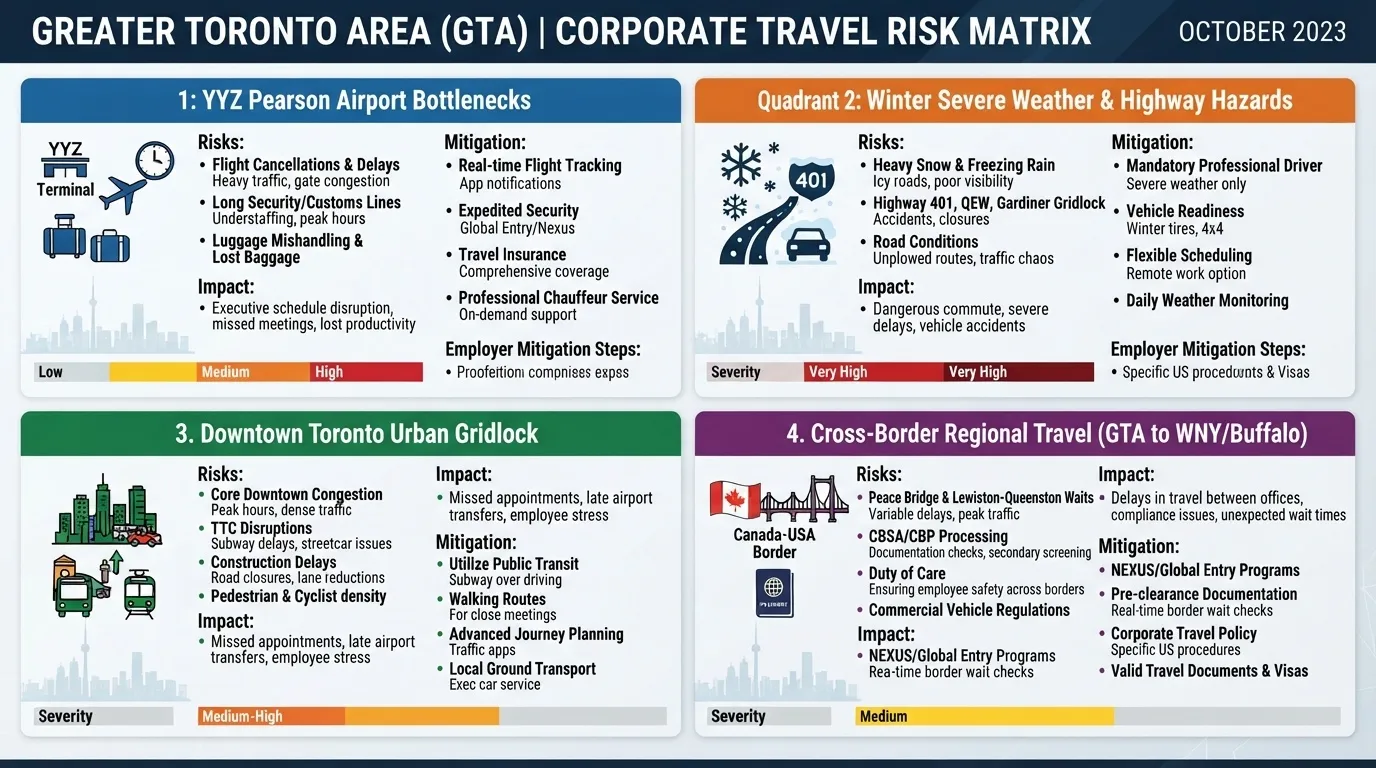
Employers fulfilling their corporate duty of care for business travel in Toronto must account for localized operational hazards that generic travel policies overlook. Beyond standard trip disruptions, ground travel across the Greater Toronto Area introduces specific safety, legal, and scheduling risks that directly impact employee well-being and corporate liability.
Winter Weather and Pearson International Congestion
Winter storms frequently trigger ground stops, de-icing delays, and sudden flight cancellations at Toronto Pearson International Airport (YYZ). When severe weather hits, thousands of travelers are stranded simultaneously, overwhelming public transit and ride-hailing supply. Under Ontario’s Occupational Health and Safety Act (OHSA), employers have a general duty to take every precaution reasonable in the circumstances for the protection of a worker. Leaving an employee stranded at YYZ late at night during a winter storm without pre-arranged, reliable transportation exposes the organization to duty-of-care liabilities.
Downtown Core Traffic Unpredictability
Toronto’s downtown traffic gridlock—exacerbated by ongoing Gardiner Expressway construction, streetcar lane restrictions, and major events—makes travel times highly variable. A commute from Pearson to the Financial District can range from 30 minutes to over two hours depending on the time of day.
Scheduling Risk: Unpredictable travel times lead to missed high-stakes meetings or rushed driving by employees attempting to make tight deadlines.
Fatigue and Stress: Prolonged transit times after long-haul flights significantly increase driver fatigue, elevating the risk of motor vehicle accidents if the employee is operating a rental or personal vehicle.
Cross-Border Trips via Buffalo Niagara International Airport (BUF)
To avoid high airfares or limited direct schedules at YYZ, Toronto-based companies frequently route employees through Buffalo Niagara International Airport. Crossing the Canada–U.S. border at the Peace Bridge or Rainbow Bridge introduces specific compliance and safety hurdles:
Commercial Insurance Verification: Personal auto policies or standard rideshare coverage often fail to cover commercial passenger transport across international borders.
Customs and Immigration Delays: Secondary inspections can stall travel for hours, requiring contingency plans for driver wait-times and secure communication.
Driver Licensing Compliance: Ground transport providers operating cross-border routes must hold valid cross-border operating authority and proper international commercial insurance.
Early-Morning Pickups and Unverified Transportation
International flights out of YYZ often require 4:00 AM or 5:00 AM airport arrivals, forcing employees to travel during off-peak hours. Relying on unvetted rideshare options or street-hailed taxis at these hours introduces significant safety vulnerabilities. Rideshare platforms typically rely on basic background checks and do not mandate real-time vehicle monitoring or professional chauffeur training. Establishing a secure protocol—such as booking through fully licensed, commercially insured ground transportation services with real-time flight tracking and vetted drivers—ensures employee safety during vulnerable travel windows.
Building a Toronto Business Travel Policy: What to Include
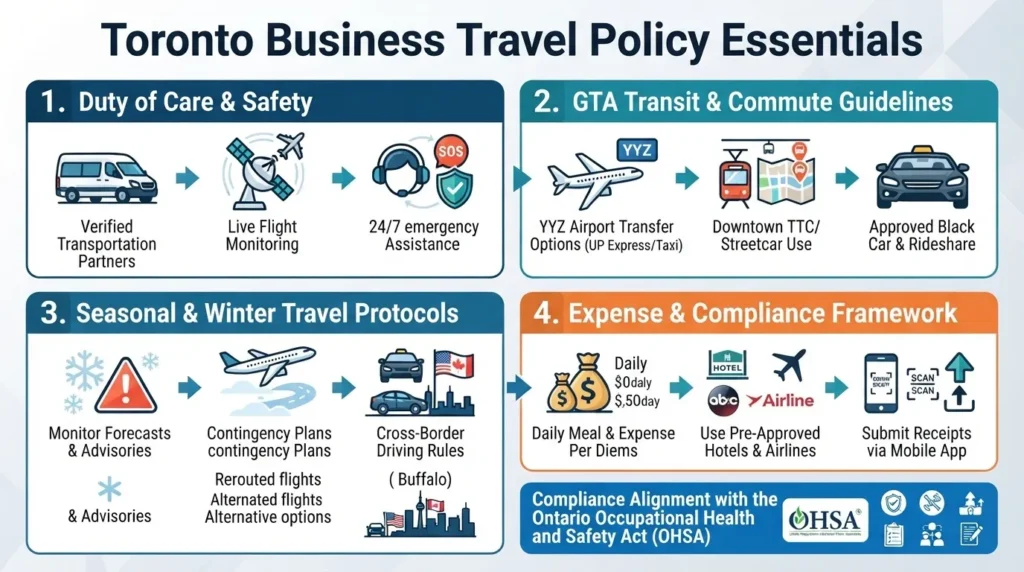
A compliant corporate duty of care for business travel Toronto policy must establish enforceable safety protocols, clear operational boundaries, and audit-ready tracking mechanisms. Incorporate the following core requirements into your travel policy checklist:
Approved Booking & Preferred Vendor List: Mandate that all airfare, lodging, and local transit be booked through designated corporate channels or vetted vendors to guarantee traveler tracking and adherence to corporate risk standards.
24/7 Emergency Contact & Crisis Protocol: Establish a documented escalation chain including internal HR/risk contacts and external duty-of-care support for real-time incidents, severe winter weather delays at Toronto Pearson (YYZ), or cross-border disruptions.
Ground Transportation Standards: Require the use of commercially licensed and insured transportation providers featuring real-time vehicle tracking, professionally background-checked chauffeurs, and pre-scheduled dispatch rather than unvetted, self-booked rideshares for high-risk or off-hours commutes.
Expense Caps & Class-of-Travel Rules: Set clear per diem limits and define specific conditions for upgrades, premium economy, or private ground transit based on employee role, flight duration, or late-night arrivals in the Greater Toronto Area.
Policy Review & Audit Frequency: Schedule mandatory annual policy audits aligned with updated legal standards under the Ontario Occupational Health and Safety Act (OHSA) and ISO 31030 risk management guidelines.
Frequently Asked Questions
Standard daily commutes from home to a primary office are generally excluded under Ontario law unless the employee is driving an employer-managed vehicle or responding to an emergency call out of hours. The moment an employee travels for official business—such as driving to Pearson Airport (YYZ), heading to a client site in Mississauga, or taking a cross-border trip to Buffalo—their transit falls under corporate duty of care. Under the Ontario Occupational Health and Safety Act (OHSA), any off-site location where work-related duties occur is legally defined as an extension of the workplace.
Standard rideshares and taxicabs rarely fulfill an employer’s legal standard of care due to unverified driver background checks, variable vehicle maintenance, and a lack of central oversight during route disruptions. To minimize corporate travel risk, organizations should utilize vetted ground transportation providers that offer licensed professional chauffeurs, commercial passenger insurance, and integrated real-time flight and vehicle tracking.
Yes, employer duty of care applies regardless of company size under Ontario workplace safety regulations and Section 217.1 of the Criminal Code of Canada (Westray Law). Small business owners and executives face the same legal exposure and potential negligence liabilities as large corporations if a traveling employee suffers a preventable injury without safety protocols in place.
The employer bears legal liability if they fail to demonstrate due diligence by taking all reasonable precautions to safeguard the employee during transit. In Ontario, injuries sustained during authorized business travel are typically managed through Workplace Safety and Insurance Board (WSIB) coverage, but employers remain exposed to civil actions or statutory fines under OHSA if they knowingly direct employees into unsafe travel conditions.
A corporate travel policy should be reviewed and updated annually, or immediately following significant changes to local transport regulations, corporate travel risk guidelines, or internal operating structures. Annual audits allow GTA firms to address evolving factors like airport traffic delays, seasonal winter driving hazards, and compliance standards such as ISO 31030.