Corporate Airport Transportation Checklist: The Complete Guide for Executives
A corporate airport transportation checklist exists to protect one thing above all else: an executive’s time. When a pickup is late, a driver can’t find the right terminal, or a flight change never reaches the chauffeur, the ripple effect touches meetings, client impressions, and the rest of the day’s schedule. This guide walks you through exactly what to confirm before, during, and after a corporate airport transfer, so nothing is left to chance.
Whether you’re an executive assistant booking travel for a CEO, a travel coordinator managing a leadership team, or a business traveler arranging your own ground transportation, this checklist covers the details that separate a smooth arrival from a stressful one.
What a Corporate Airport Transportation Checklist Actually Covers
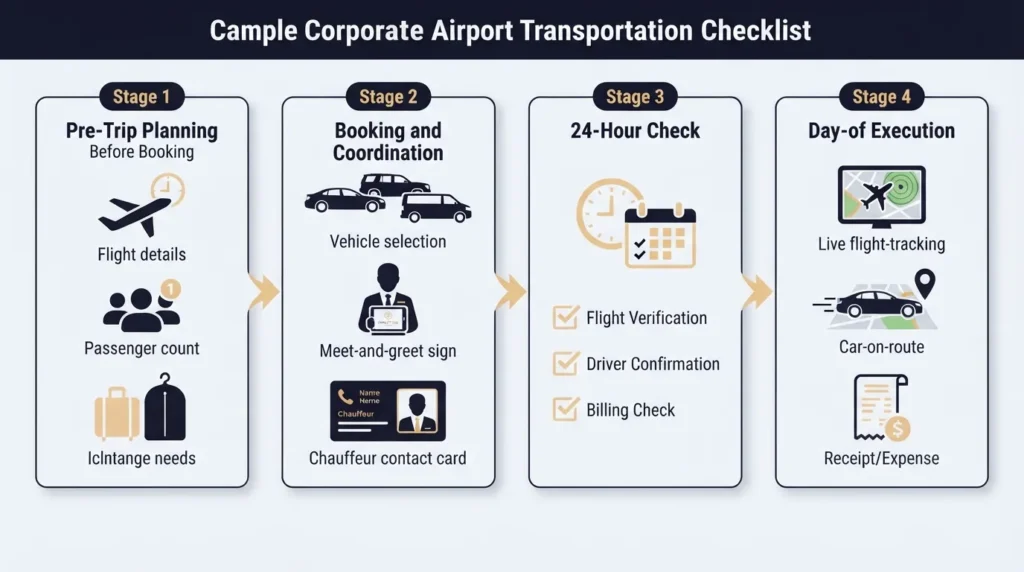
A complete checklist for corporate ground transportation breaks down into four practical stages: what you confirm before booking, what you lock in when you book, what you verify the day before travel, and what happens on the actual day of the trip. Each stage catches a different type of mistake, so skipping one usually means the problem shows up later, at the worst possible moment — curbside, with a tired executive waiting.
The four stages at a glance:
- Pre-Trip Planning — travel details, passenger information, vehicle needs
- Booking and Coordination — vendor selection, meet-and-greet setup, authorizations
- The 24-Hour Check — flight verification, chauffeur confirmation, billing
- Day-of Execution — flight tracking, contingency planning, expense capture
Stage 1: Pre-Trip Planning
Start with the full itinerary, not just a flight number. A chauffeur working from a flight number alone can only guess at the rest. Give the transportation provider enough detail that they can plan the pickup properly and adapt if something changes.
- Traveler details: full legal name, mobile number, airline, flight number, terminal (if known)
- Arrival or departure time: including boarding time for departures, especially for international travel
- Pickup and drop-off addresses: building names, hotel entrances, suite numbers, or private terminal details
- Passenger count: traveling alone, with colleagues, or with a client changes vehicle sizing
- Luggage and extras: oversized bags, presentation materials, or equipment that needs space
- Accessibility or child safety needs: communicated in advance, never left for curbside discussion
Choosing the Right Vehicle for the Trip
Vehicle choice should reflect more than headcount. Luggage volume, trip length, and the image a company wants to present all factor in. Here’s how the common options compare:
| Vehicle Type | Best For | Typical Capacity |
|---|---|---|
| Luxury Sedan | One executive traveling light, discreet solo transfers | 1–3 passengers, 2 standard bags |
| SUV | Extra luggage, small leadership teams, working during the ride | 1–4 passengers, more luggage room |
| Executive Van | Larger corporate groups, coordinated team arrivals | 6+ passengers with group luggage |
The cheapest available option isn’t always the most efficient one. A vehicle that’s too small forces last-minute changes at the curb, while booking more space than needed can be the right call when an executive needs room to work or travel with sensitive equipment. If you’re weighing this for a specific city, our corporate limo service in Toronto page breaks down vehicle options and typical use cases in more detail.
Domestic vs. International Corporate Transfers
The checklist doesn’t change dramatically between domestic and international trips, but the timing and a few details do. Here’s the practical difference:
| Factor | Domestic Transfer | International Transfer |
|---|---|---|
| Arrival buffer | Around 45–60 minutes after landing before pickup | 90 minutes or more, to allow for customs and immigration |
| Departure timing | Based on security line and terminal traffic | Earlier boarding cutoffs, so pickup times move earlier too |
| Documentation | Not typically required by the transportation provider | Traveler should have passport and visa details confirmed separately with their travel coordinator |
| Flight monitoring | Standard delay tracking | Should also account for weather diversions and connection delays |
The buffer numbers above are general planning guidance, not fixed rules — actual timing still depends on the specific airport, time of day, and how busy customs happens to be that day.
Solo Executive Travel vs. Group or Event Transportation
A single executive with a carry-on has very different needs from a delegation arriving for a conference. For solo travel, the checklist stays simple: one vehicle, one pickup point, clear driver contact information, and a discreet meet-and-greet if privacy matters.
For group or event travel, add these to your checklist:
- Designate one organizer or coordinator as the single point of contact — not five people sending separate change requests
- Confirm whether the group arrives on one flight or several, since staggered arrivals may need staggered vehicles
- Coordinate multiple vehicles under one booking reference so the provider can track the whole group, not separate trips
- Plan for group luggage volume, especially if the trip involves conference materials or equipment
Stage 2: Booking and Coordination
Once the details are gathered, booking is where you lock in reliability. This is also where corporate accounts tend to save the most time long-term, since preferences only need to be set once.
- Book with a trusted provider: a licensed corporate car service that can produce driver credentials, insurance details, and vehicle documentation on request
- Request a meet-and-greet: the chauffeur waits inside baggage claim with a name sign, or arranges private curbside pickup if that’s preferred
- Set who can authorize changes: one lead coordinator should have the authority to adjust the booking, not multiple people giving conflicting instructions
- Save the driver’s contact details: name, phone number, and vehicle description, shared with both the traveler and the coordinator
Stage 3: The 24-Hour Check
This is the step most people skip, and it’s the one that catches the most problems. About 24 hours before travel, run through this short review:
- Review the itinerary for delayed flights, terminal changes, or revised meeting times
- Confirm the chauffeur is assigned and, if needed, has signed an NDA for a privacy-sensitive trip
- Verify the payment method, including how tips and tolls will be handled, so nothing surprises the traveler afterward
- Confirm how the chauffeur and passenger will connect — curbside, a designated pickup zone, or an inside meet-and-greet
Stage 4: Day-of Execution
On the actual travel day, the checklist becomes about monitoring and response rather than planning.
- Live flight tracking: the provider should be actively monitoring the flight for early arrivals or delays, not waiting for the traveler to call
- A contingency plan: what happens if there’s a cancellation, a gate change, or heavy traffic on the route
- Expense capture: digital receipts logged through a corporate travel platform as the trip happens, not reconstructed later from memory
Protecting Executive Privacy During the Transfer
For senior leaders, clients, or board members, an airport transfer is really an extension of the workday. Getting privacy right doesn’t need to be complicated, but it does need to be planned in advance rather than negotiated at the curb.
- Share only the operational details a provider needs to deliver the trip — not the traveler’s full schedule or business agenda
- For sensitive travel, request an NDA from the assigned chauffeur ahead of time, not on the day of the trip
- Ask for a discreet pickup: limited signage, no unnecessary conversation, and a specific entrance if the traveler prefers to avoid public areas
- Confirm who besides the traveler is authorized to receive trip updates, so the chauffeur isn’t put in the position of deciding on the spot
Handling Delays, Changes, and Multiple Stops
The strongest bookings plan for what might change, rather than assuming everything will go as scheduled. Before the trip, ask your provider directly how they handle wait time, flight delays, added stops, and late cancellations — and get the answer in writing, not just verbally.
If the traveler needs to stop at an office, hotel, or meeting venue before the final destination, include that in the original booking. A chauffeur who knows the full route in advance can plan timing accurately; a chauffeur who learns about an extra stop mid-trip is working with guesswork.
Confirm the cancellation and change window before you book. A common structure is free cancellation up to 24 hours before pickup, a partial charge inside that window, and automatic rebooking at no extra cost if the delay is due to a flight issue rather than the traveler’s own change of plans. Terms vary by provider, so always get this confirmed directly rather than assuming.
Common Mistakes That Undo a Good Checklist
Even a detailed checklist can fail if these get overlooked:
- Booking off an approximate flight time instead of the confirmed flight number — this leaves too much room for the driver to guess wrong
- Letting multiple people manage one booking — conflicting change requests are one of the most common causes of a missed pickup
- Skipping the 24-hour check because the trip was “already confirmed” weeks earlier — schedules shift more often than people expect
- Choosing a vehicle based on price alone without accounting for luggage or passenger count
- Not confirming how the chauffeur and passenger will find each other — this single detail causes more day-of stress than almost anything else
Frequently Asked Questions
How early should a corporate car arrive before pickup?
For departures, the chauffeur should typically be in position 10–15 minutes before the scheduled pickup time, ready before the passenger steps outside rather than arriving at the exact minute. For arrivals, the provider should be actively tracking the flight and adjusting pickup timing to the actual landing time rather than the originally scheduled one.
What should I check before leaving for the airport for a corporate pickup?
Confirm the driver has been assigned, double-check the pickup location and terminal, make sure the traveler’s phone is on and reachable, and verify that any last-minute meeting or itinerary changes have already been passed to the provider.
What happens if the flight is delayed or cancelled?
A professionally managed transfer monitors the flight directly and adjusts the pickup time automatically. If the delay is significant, most providers will reschedule at no extra charge, since the disruption isn’t the traveler’s fault. This is exactly why confirming the provider’s delay policy in advance matters.
Is a meet-and-greet or curbside pickup better for corporate travel?
It depends on the traveler’s priorities. A meet-and-greet inside baggage claim is more personal and helpful with luggage, but it’s less private since the chauffeur holds a name sign in a public area. Curbside pickup is faster and more discreet, which is often the better choice for high-profile or privacy-sensitive travelers.
Do I need to verify a driver’s credentials for corporate travel?
Yes. Licensed providers should be able to confirm chauffeur licensing, background checks, and vehicle insurance on request. According to the International Air Transport Association, verifiable credentials are increasingly part of how professional ground transportation providers demonstrate compliance and accountability.
A Simple Reference Checklist
Before booking:
- Flight number, terminal, and arrival/departure time confirmed
- Passenger count and luggage needs noted
- Vehicle type selected based on trip, not just headcount
- Preferences (route, privacy, accessibility) shared in advance
24 hours before:
- Itinerary rechecked for changes
- Chauffeur and vehicle confirmed
- Payment method and billing details verified
Day of travel:
- Flight actively tracked by the provider
- Contingency plan in place for delays
- Receipts logged as the trip happens
Keep This on Hand for Future Trips
If your company handles recurring executive travel, it’s worth keeping a saved profile of preferences — vehicle type, regular pickup locations, billing details, and approved contacts — so this checklist doesn’t need to be rebuilt from scratch every time. For pricing on specific routes, our Toronto airport limo rates page is a useful starting point, and if you’re coordinating travel across the region, our downtown Toronto limo service and Mississauga limo service pages cover pickup details for those areas specifically. You can also browse more planning guides on our travel blog.
Need a reliable corporate airport transfer?
Vetted chauffeurs, flight tracking, and privacy-conscious service for executives and business travelers across the region.
Book Corporate TransportationExplore Airport Topics
Our Services
Featured Travel Guides
Industry & Safety Standards
Our Service Guarantee
Every guide is written from real chauffeur and dispatch experience — flat-rate pricing, licensed vehicles and 24/7 flight-monitored pickups across Toronto & the GTA.