Mercedes Sprinter Luggage Capacity: How Much Actually Fits
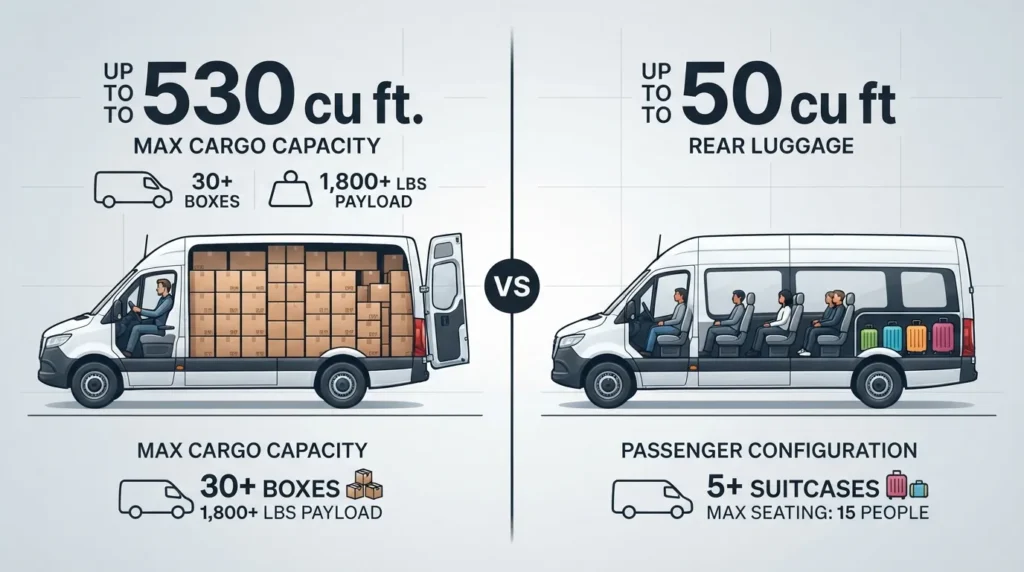
If you’re trying to figure out Mercedes Sprinter luggage capacity, the honest answer depends on which Sprinter you’re dealing with. A cargo-configured Sprinter can hold anywhere from 319 to 533 cubic feet of gear, while a passenger Sprinter set up for group travel gives you around 117 cubic feet of dedicated luggage space in the back — enough for roughly 10 to 15 large suitcases, depending on how many seats are installed and how much breathing room your group needs.
Below, we’ll break down exactly what that means for cargo vans, passenger vans, and the specific case most people searching this term actually care about: fitting a group and their bags in for an airport run.
Cargo van or passenger van — why it changes everything
The Sprinter isn’t one van with one luggage figure. It’s built in two very different configurations, and mixing them up is the number one reason people get confused by the numbers they find online.
A cargo van has no rear seats at all, so the entire back of the vehicle is open storage. A passenger van gives up most of that space to bench seating, leaving a smaller, dedicated luggage area behind the last row. If you’re comparing a number you saw for a cargo Sprinter against a passenger Sprinter, you’re comparing two different vehicles.
Cargo van capacity by length and roof height
If you’re hauling equipment, freight, or luggage with no need for passenger seating, this is where the Sprinter really shows its size. Capacity scales up with wheelbase length and roof height:
| Configuration | Cargo volume | Payload capacity |
|---|---|---|
| Standard length (144″ wheelbase) | About 319 cu. ft. | Up to roughly 4,211 lbs |
| Long length (170″ wheelbase) | About 371–488 cu. ft. | Varies by roof height and drivetrain |
| Extended length (170″ wheelbase, extended) | Up to about 533 cu. ft. | Up to roughly 6,812 lbs |
Figures are manufacturer-published ranges and will shift slightly depending on roof height, drivetrain, and exact trim. Standing height in the standard cargo configuration is around 68 inches, which is tall enough for most adults to walk upright while loading.
One thing worth understanding: payload capacity and cargo volume aren’t the same thing. Volume tells you how much space you have; payload tells you how much weight the van is rated to carry safely, including passengers, fuel, and everything loaded inside. A van can technically have room for more boxes than its payload rating allows, especially with dense or heavy cargo.
Passenger van luggage space — the number most people searching this actually want
If you’re moving a group of people rather than freight, the picture changes. With all seats installed, a 12 to 15-passenger Sprinter typically has around 117 cubic feet of dedicated luggage space behind the last row of bench seating. In practical terms, that space comfortably holds 10 to 15 large checked suitcases, along with room for a few oversized items like golf bags, strollers, or ski gear.
How many people does a Sprinter passenger van actually fit?
Most passenger Sprinters are configured for 12 to 15 people, arranged in rows of bench seating. The related search “14 passenger Sprinter luggage space” comes up a lot, and here’s the practical answer: Mercedes doesn’t publish a separate cargo figure for a 14-passenger layout, but in day-to-day fleet use, dropping one seat from the full 15-passenger setup typically opens up a bit of extra floor space at the back. It’s a small difference, not a dramatic one, but it’s often enough to fit one or two additional oversized bags without needing to remove more seating.
A simple way to estimate how many bags will fit
If you want to sanity-check whether your group’s luggage will fit, here’s a rough method you can use yourself:
Available luggage space (cu. ft.) ÷ average suitcase size (cu. ft.) = estimated number of bags.
A typical large hard-shell checked suitcase runs somewhere around 4 to 5 cubic feet. Using that as an example, 117 cubic feet of luggage space divided by roughly 4.5 cubic feet per bag lands right around 25 bags in theory — but real-world packing never uses 100% of the space, since bags are irregular shapes, wheels and handles waste room, and you need to be able to actually close the rear doors. That’s exactly why Mercedes’ own real-world estimate lands closer to 10–15 bags rather than a pure math result. Treat the formula as a starting point, not a guarantee, and expect your actual count to land somewhere below the theoretical maximum.
Getting more room when you need it
If your group is smaller than the van’s full seating capacity but everyone is traveling with an oversized bag, golf clubs, or ski equipment, ask whether one or two of the rearmost seats can be removed before the trip. Opening up that extra row often makes the difference between a tight squeeze and a comfortable load, especially for airport transfers where checked luggage tends to run larger than everyday travel bags.
Real scenarios: matching group size to luggage needs
Numbers on a spec sheet only tell you so much. Here’s how the space typically plays out for the kinds of trips people actually book a Sprinter for:
- A family of 4–6 heading to the airport: Easily fits with room to spare. Expect two full-size checked bags per person plus carry-ons without needing to touch the seating.
- A group of 10–12 with standard luggage: Comfortable fit at one to two checked bags per person, using most but not all of the dedicated luggage area.
- A full 14–15 passenger group with golf clubs, ski bags, or extra-large suitcases: This is where it gets tight. Removing one or two rear seats ahead of time is the difference between everything fitting cleanly and bags being stacked on laps.
- A corporate group with carry-on-only luggage: The full 15-passenger layout works fine as-is, since the luggage demand is light.
This is exactly the kind of planning question our team fields regularly for group airport transfers across the GTA — whether you’re being picked up in Mississauga, Markham, or Oakville, letting us know your group size and luggage ahead of time means the right vehicle — and the right seating configuration — is already sorted before you arrive.
How the Sprinter compares to other options
Is a Mercedes Sprinter bigger than a Ford Transit?
In its largest configurations, the Sprinter is generally recognized as offering more overall cargo volume than the largest Transit configurations, largely because Mercedes offers a taller high-roof option and an extended-length body style. That said, both vans come in multiple lengths and roof heights, and Ford has closed the gap significantly in recent model years. If you’re comparing a specific trim of each, it’s worth checking the manufacturer’s current configurator, since exact figures shift by model year.
Is a Freightliner Sprinter the same as a Mercedes Sprinter?
Yes, essentially. The Sprinter was sold under the Freightliner badge in North America for a number of years, built on the same underlying platform as the Mercedes-Benz version. Today it’s sold under the Mercedes-Benz Vans brand, but if you come across an older Freightliner Sprinter, you’re looking at the same vehicle family — the luggage and cargo figures above apply the same way.
Frequently asked questions
How much weight can you carry in a Mercedes Sprinter?
Payload capacity ranges from roughly 3,100 lbs up to about 6,800 lbs depending on the length, roof height, and drivetrain. This weight allowance covers passengers, fuel, and everything you load into the van, so it’s worth checking the specific trim’s rating rather than assuming the top figure applies to every configuration.
How big is the back of a Mercedes Sprinter van?
In a passenger configuration with all seats installed, the dedicated luggage area behind the last row is around 117 cubic feet. In a cargo configuration with no seating, that number grows dramatically, up to around 533 cubic feet in the largest extended-length, high-roof version.
What are the interior dimensions of a Mercedes-Benz Sprinter cargo van?
The standard cargo configuration offers about 68 inches of standing height, tall enough for most adults to move around without stooping. Length and width scale up with the 144-inch and 170-inch wheelbase options, which is what drives the difference between the roughly 319 cu. ft. and 533 cu. ft. figures.
For most groups traveling to or from the airport, a passenger Sprinter’s roughly 117 cubic feet of luggage space and 10–15 suitcase capacity is more than enough. The exception is a full group with oversized items, where planning ahead — either by choosing a 14-passenger layout or requesting a seat removed — makes the trip far smoother. If you’re not sure which configuration fits your group’s size and luggage, it’s always worth mentioning your numbers when booking so the right vehicle is arranged in advance.
Planning a group airport transfer?
Tell us your group size and luggage when you book and we’ll make sure the right vehicle and seating setup is ready. We provide Sprinter and limo transfers across Toronto, Hamilton, Waterloo, Barrie, and surrounding areas, along with corporate travel options for teams moving with heavier luggage. You can check current pricing on our Toronto airport limo rates page, or browse more travel planning tips on our blog.
Sources
Cargo and passenger van specifications referenced from Mercedes-Benz Vans Canada — Sprinter Passenger Van and Mercedes-Benz Vans — Sprinter Cargo Van.
Explore Airport Topics
Our Services
Featured Travel Guides
Industry & Safety Standards
Our Service Guarantee
Every guide is written from real chauffeur and dispatch experience — flat-rate pricing, licensed vehicles and 24/7 flight-monitored pickups across Toronto & the GTA.