Map of Terminal 1 Pearson Airport Toronto – Complete YYZ Guide
The Problem – Why Terminal 1 Can Be Overwhelming
Toronto Pearson is Canada largest airport. Terminal 1 alone handles over 25 million passengers every year. It spans three levels with more than 58 gates spread across three concourses.
For a first time traveler, finding your check in counter, security entrance, or baggage claim can feel like solving a puzzle. The terminal is massive. Signs are everywhere but not always clear. And if you are in a hurry, stress goes up quickly.
Many travelers walk in circles looking for their gate. Others miss their flight because they went to the wrong level. Some arrive at the wrong terminal entirely because they did not check which airline uses which building.
This happens to first time flyers and even frequent travelers who are used to a different airport layout.
The Solution – A Clear Guide to Terminal 1 Layout
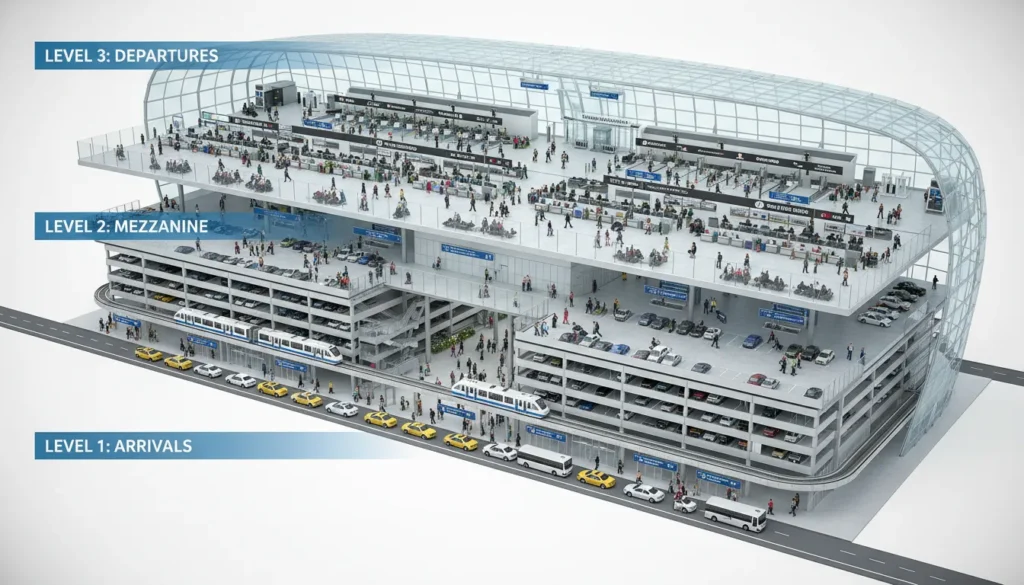
The good news is Terminal 1 is actually very organized once you understand its three level structure. Each level has one specific job. Nothing overlaps.
Level 1 is for arrivals only. You come here when your flight lands. Baggage claim is here. Ground transportation including taxis, rideshares, and UP Express train is also here.
Level 2 is the mezzanine. This floor connects you to parking garages and the Terminal Link train that goes to Terminal 3. Most travelers do not spend much time here.
Level 3 is for departures and check in. All 200 plus check in counters are here. Security screening is here. And all gates D, E, and F are accessed from this level.
Once you know which level does what, navigating Terminal 1 becomes much simpler.
Why You Should Read This Complete Guide
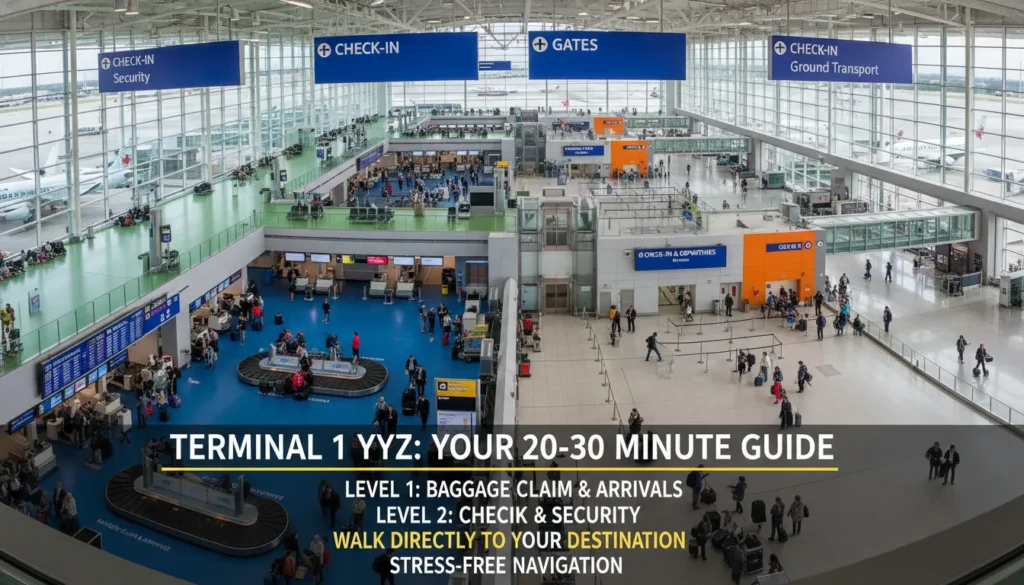
Knowing the Terminal 1 map before you reach the airport saves you at least 20 to 30 minutes. You will not wander around looking for signs. You will walk directly to where you need to go.
This guide gives you every detail. Which airlines use Terminal 1. Where are D gates versus E gates versus F gates. How to get from arrivals to ground transportation. Where to meet your driver if someone is picking you up.
Read through completely. By the end, you will know Terminal 1 better than some airport staff.
Terminal 1 Overview – Three Levels, Three Purposes
Terminal 1 at Toronto Pearson opened in 2004. It is the largest terminal in Canada with 346,000 square meters of space. The building uses a hammerhead design with three piers extending outward.
Level 3
Departures
Check in, security, all gates
Level 2
Mezzanine
Parking access, Terminal Link train
Level 1
Arrivals
Baggage claim, ground transportation
The terminal handles domestic flights within Canada, international flights from overseas, and transborder flights to the United States. Each flight type uses a different concourse.
Level 3 – Departures and Check In
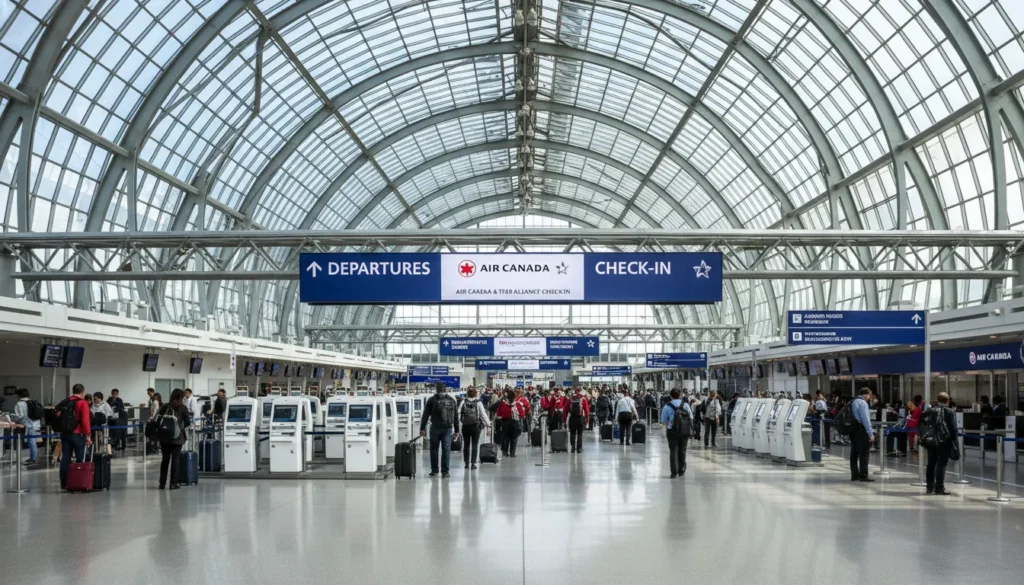
Level 3 is where your journey at Pearson begins if you are flying out. This floor contains everything you need before security.
Check In Area
More than 200 check in counters line the departures hall. Air Canada occupies the largest section. Other Star Alliance airlines have counters nearby. Self service kiosks are available for most airlines to print bag tags and boarding passes.
Security Screening
After checking in, you proceed to security. Terminal 1 has multiple security checkpoints. Domestic and international flights use different entrances. U S bound passengers have their own dedicated security area leading to U S preclearance.
What to expect at security:
Remove laptops and liquids from bags
Empty pockets before walking through scanner
Wait times vary from 5 to 25 minutes depending on time of day
Level 3 Gates – D, E, and F Explained
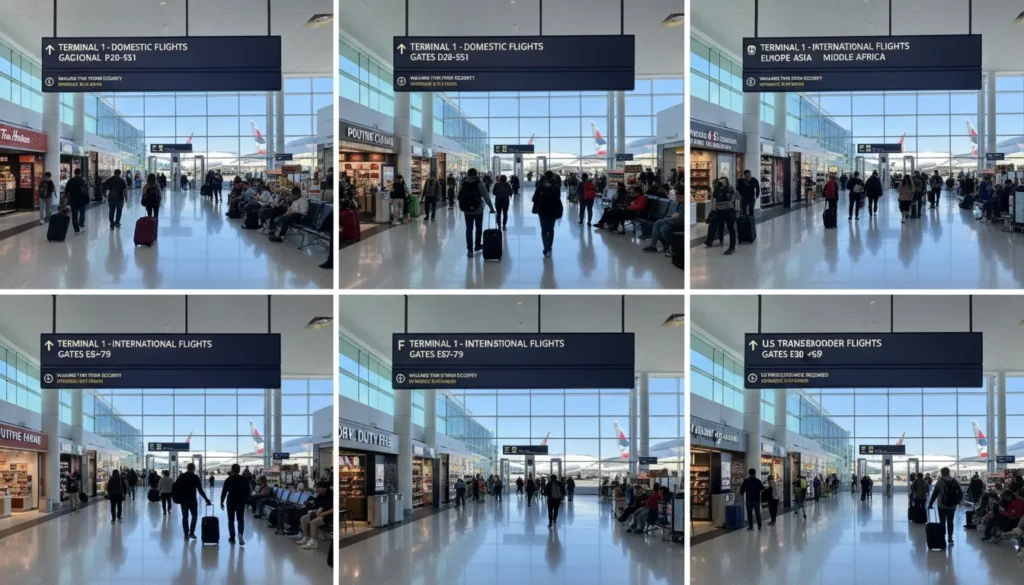
Once you pass security, you enter the airside area where gates are located. Terminal 1 has three concourses. Each serves a different type of flight.
D Gates (D20 to D51)
D gates serve domestic flights within Canada. Airlines using these gates include Air Canada and its regional partners. This concourse is located centrally in the terminal. Walking from security to the furthest D gate takes about 10 minutes.
Amenities near D gates include coffee shops, fast food, and charging stations.
E Gates (E67 to E79)
E gates serve international flights to destinations outside Canada and the United States. This includes flights to London, Frankfurt, Tokyo, Dubai, and Delhi. The E concourse is designed to handle wide body aircraft including the Airbus A380.
Walking time from security to E gates is approximately 12 to 15 minutes.
F Gates (F30 to F69)
F gates serve transborder flights to the United States. Passengers using these gates must go through U S customs and immigration at Pearson before boarding. This process is called preclearance.
The F concourse has duty free shops and more dining options than other gates. Walking time from security to F gates is about 10 minutes.
Level 2 – Mezzanine and Connections
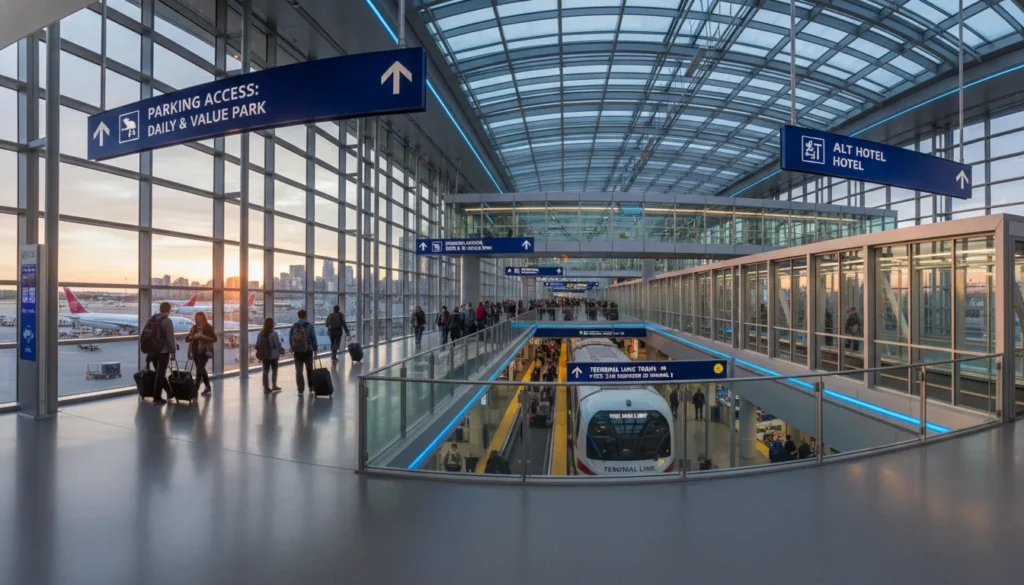
Level 2 is the middle floor. Most travelers pass through here briefly without spending much time.
Parking Access
From Level 2, you can walk to the parking garages. Daily parking, value parking, and premium parking are all connected via enclosed walkways.
Terminal Link Train
The Terminal Link train connects Terminal 1 to Terminal 3. Boarding platforms are on Level 2. The train is free and runs 24 hours a day, 7 days a week. Trains come every 4 to 8 minutes. The ride takes 2 to 4 minutes between terminals.
Hotel Walkway
A pedestrian walkway from Level 2 connects to the Alt Hotel. This is useful for passengers staying overnight before an early morning flight.
Level 1 – Arrivals and Ground Transportation
Level 1 is where you arrive after your flight lands. This floor handles baggage claim and all options for leaving the airport.
Baggage Claim
Carousels are numbered and clearly marked. Check the screens above each carousel to find your flight number. Baggage typically arrives 15 to 25 minutes after the plane parks at the gate.
For international arrivals, you clear customs before reaching baggage claim. For U S arrivals with preclearance, you pick up your bags then exit directly to the arrivals hall.
Ground Transportation Options
Once you have your bags, you have several ways to leave the airport.
Taxis are available just outside the arrivals doors. A uniformed attendant will direct you to the next available cab. Taxis accept credit cards and cash.
Rideshares including Uber and Lyft pick up from designated areas on Level 1. Follow signs for rideshare pickup. Wait times during peak hours can be 10 to 15 minutes.
UP Express train connects Pearson to downtown Toronto at Union Station. The train departs every 15 minutes. Travel time is 25 minutes. Tickets can be purchased at the station or online.
Private car services and limos meet passengers at arrivals with name signs. This is the most convenient option if you have pre booked.
Meeting Someone Arriving
If you are picking up a friend or family member, wait in the arrivals level. Each door is labeled A through F. Tell the arriving passenger which door number you are near.
Pro tip from local drivers: If arrivals level is very busy, ask your passenger to walk up to departures level. Pickup there is often faster because fewer cars are waiting.
Which Airlines Use Terminal 1
Terminal 1 is the primary hub for Air Canada and Star Alliance partners. If you are flying any of these airlines, you will depart from or arrive at Terminal 1.
Full service airlines at Terminal 1:
Air Canada (all flights)
United Airlines
Lufthansa
Austrian Airlines
Swiss International Air Lines
Brussels Airlines
Air China
Emirates
Etihad Airways
EgyptAir
Ethiopian Airlines
Important note: WestJet and Porter Airlines operate from Terminal 3. Always check your ticket before coming to the airport. Going to the wrong terminal adds 15 to 20 minutes of travel time between buildings.
How Early to Arrive at Terminal 1
Arrival time depends on your destination. Do not cut it close. Security lines can be long during peak hours.
Domestic flights within Canada:
Arrive at least 2 hours before departure.
Flights to the United States:
Arrive at least 3 hours before departure. U S preclearance adds significant time.
International flights to other countries:
Arrive at least 3 hours before departure.
Peak hours at Terminal 1 are weekdays from 6 AM to 9 AM and 3 PM to 7 PM. Weekend mornings are also busy. If your flight is during these times, add an extra 30 minutes.
Can You Walk Between Terminal 1 and Terminal 3
No. Walking between terminals is not practical. The distance is about 1.2 kilometers. Walking takes 20 to 25 minutes and requires crossing roads and parking lots.
Use the Terminal Link train instead:
Free to use
Runs 24 hours a day
Trains every 4 to 8 minutes
Ride takes 2 to 4 minutes
Board from Level 2 at Terminal 1
The train is fully accessible for wheelchairs and strollers. No ticket or payment required. Just board and ride.
Amenities Inside Terminal 1
Terminal 1 has everything you need for a comfortable wait before your flight.
Dining options:
Wahlburgers
Boccone Trattoria
Starbucks locations throughout
Tim Hortons
Pizza and sandwich shops near most gates
Shopping:
Duty free shops in international area
Luxury brands including Gucci and Burberry
Electronics and bookstores
Travel essentials and pharmacies
Lounges:
Air Canada Maple Leaf Lounges are located near D gates and E gates. Plaza Premium Lounge is available for all passengers regardless of airline. Entry costs 40 to 70 Canadian dollars and includes food, drinks, showers, and Wi Fi.
Family services:
Nursing rooms
Play areas near gate D37
Pet relief areas
Stroller friendly walkways
Other services:
Free unlimited Wi Fi network named Toronto Pearson Wi Fi
Charging stations at most gates
Water refill stations
Prayer and quiet rooms
Parking at Terminal 1
Parking at Pearson is not free. Several options are available depending on your budget and how long you are leaving your car.
Daily parking garage:
Connected directly to Terminal 1. Cost is 33 to 50 dollars per day. Most convenient option for short trips.
Value parking:
Located at Viscount Station. Free train shuttle takes you to Terminal 1. Cost is approximately 25 dollars per day.
Offsite parking:
Private lots near the airport cost 5 to 10 dollars per day. Most offer free shuttles to the terminal. Book online in advance for best rates.
Frequently Asked Questions
Check your boarding pass for the gate number. D gates are for domestic flights. E gates are for international. F gates are for US flights. Follow overhead signs after security.
Departures is on Level 3. All check in counters and security checkpoints are on this level.
Arrivals is on Level 1. Baggage claim and ground transportation are here.
Yes. Landside areas near check in have benches. Airside areas near D20 to D30 have quieter spots. Sleep pods are available for approximately 30 dollars per hour.
Yes. Connect to Toronto Pearson Wi Fi network. No password required. Unlimited usage.
Take the UP Express train from Level 1. Train departs every 15 minutes. Travel time to Union Station is 25 minutes. Cost is approximately 12 to 24 dollars depending on ticket type.
Most drivers wait at arrivals level near the numbered doors A through F. Tell your driver which door number you are closest to. For private car services, your driver will have a name sign.
Need Airport Limo Service at Terminal 1
If you are arriving at Terminal 1 and need a ride to your hotel or final destination, we are here to help.
VIP Airport Limo provides flat rate transportation from Pearson to anywhere in Toronto and the GTA. Your chauffeur meets you at arrivals with a name sign. No waiting in taxi lines. No surge pricing.
We track your flight. If your plane is delayed, we adjust pickup automatically at no extra charge.
Final Tips for Navigating Terminal 1
Know your airline before you come. Air Canada and Star Alliance use Terminal 1. WestJet and Porter use Terminal 3.
Check your departure level. Level 3 is for departures. Level 1 is for arrivals.
Give yourself extra time. Domestic flights need 2 hours. US and international need 3 hours.
Use the Terminal Link train to move between Terminal 1 and Terminal 3. Do not walk.
Download the Pearson Airport app for live gate updates and interactive maps.
Save this guide for your next trip through Toronto Pearson.
Explore Airport Topics
Our Services
Featured Travel Guides
How Much to Tip an Airport Limo Driver in Toronto
Wedding Limo Timeline Planning Guide Toronto
Toronto Pearson Airport Arrivals Guide
Taxi Fare From Pearson Airport to Mississauga
Pearson Airport to Hamilton — Distance & Travel Guide
Benefits of a Corporate Limo Account for Businesses
View All Travel Guides →Industry & Safety Standards
Our Service Guarantee
Every guide is written from real chauffeur and dispatch experience — flat-rate pricing, licensed vehicles and 24/7 flight-monitored pickups across Toronto & the GTA.
24/7 Quick Response
+1 (647) 654-4915