Understanding Limo Insurance and Liability Coverage: Types, Limits & What's Covered
What Does Limo Liability Insurance Cover?
Limousine liability insurance is designed to protect your business when an accident results in harm to other people or their property. Because livery vehicles carry paying passengers and often operate larger, heavier vehicles, standard commercial auto policies require specific endorsements to cover all aspects of road liability.
Below is a breakdown of the primary coverages that make up a complete limo liability insurance package.
Bodily Injury Liability
Bodily injury liability covers financial damages if your chauffeur causes an accident that injures individuals outside your vehicle, such as pedestrians, bicyclists, or occupants of another car. This pays for third-party emergency medical care, ongoing rehabilitation, lost wages, and pain and suffering claims.
Crucially, bodily injury liability also covers your legal defense fees and legal representation costs if an injured third party files a lawsuit against your company.
Property Damage Liability
If your limousine damages external property during an accident, property damage liability absorbs those costs. This includes repairs to other vehicles, replacement of damaged streetlights or guardrails, and structural repairs to private structures or storefronts.
Because commercial stretch limousines and luxury buses carry significant mass, property damage costs in a multi-vehicle collision can escalate quickly, making sufficient limits vital.
Passenger Hazard/Liability Coverage
Standard personal auto policies and basic commercial lines specifically exclude coverage for passengers paying a fee for transportation. Passenger hazard coverage (often integrated directly into commercial livery liability) explicitly covers bodily injury or death suffered by paying passengers inside your vehicle.
Whether a passenger is injured during a high-speed collision or slips while entering or exiting the vehicle, this endorsement covers their medical costs and protects your business from direct passenger lawsuits.
Uninsured Motorist, Collision/Comprehensive, Umbrella
Beyond basic liability, complete fleet protection relies on several complementary coverages:
Uninsured / Underinsured Motorist (UM/UIM): Pays for injuries to your chauffeur and passengers if an at-fault third-party driver flees the scene or carries inadequate insurance limits.
Collision Coverage: Pays to repair or replace your limousine after an impact with another vehicle or stationary object, regardless of fault.
Comprehensive Coverage: Protects your vehicles against non-collision physical losses, including theft, hail damage, fallen trees, fire, and windshield cracks.
Commercial Umbrella Insurance: Adds a second tier of liability coverage (e.g., $1 Million to $10 Million) that kicks in after your primary liability limits are exhausted during a catastrophic lawsuit.
Limo Insurance Coverage Summary
Coverage Type
What It Covers
Required?
Bodily Injury Liability
Third-party injuries, medical bills, lost wages, and legal defense fees.
Mandatory by federal & state law
Property Damage Liability
Damage caused by your vehicle to third-party cars or physical property.
Mandatory by federal & state law
Passenger Hazard Coverage
Injuries and medical costs for paying clients inside your limousine.
Mandatory for livery/for-hire
Uninsured Motorist (UM/UIM)
Chauffeur and passenger injury costs when hit by an underinsured driver.
Required in many states
Collision Coverage
Physical repair or cash replacement value for your own damaged vehicle.
Optional (Lender requirement)
Comprehensive Coverage
Vehicle damage from theft, fire, storms, or vandalism.
Optional (Lender requirement)
Commercial Umbrella
Additional liability limits ($1M+) stacked above primary policy caps.
Optional (Airport/Contract req.)
Table of Contents
Split Limits & Liability Numbers Explained
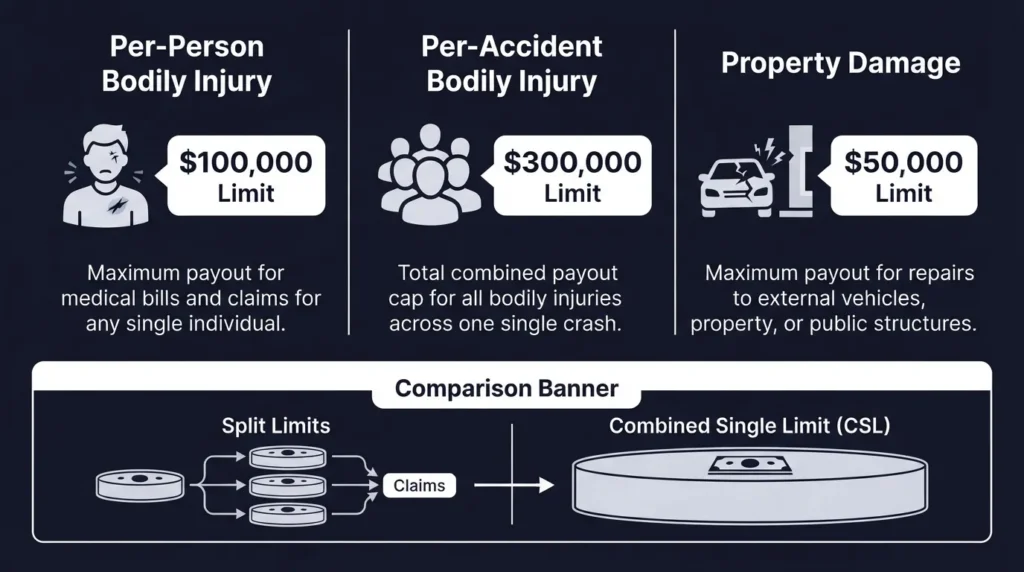
When evaluating commercial auto insurance, liability coverage is frequently expressed as a set of three numbers, such as 100/300/50 or 250/500/100. These figures represent a Split Limit policy structure, establishing distinct maximum payouts for different types of damages in a single accident.
What Does $100,000 Liability Mean?
In a split limit policy, the first number ($100,000) represents the Bodily Injury Liability Limit Per Person.
This is the maximum amount your insurer will pay for medical bills, lost wages, and legal claims for any single individual injured in an accident where your driver is at fault.
Why it matters: If an injured passenger or third-party driver incurs $140,000 in medical expenses, a $100,000 limit leaves your limousine company directly responsible for paying the remaining $40,000 out of pocket.
What Does $300,000 Liability Mean?
The second number ($300,000) represents the Total Bodily Injury Liability Limit Per Accident.
This caps the total amount the insurance company will pay out for bodily injuries across all injured parties combined in a single incident, regardless of how many people are hurt.
Why it matters: If four passengers in your stretch limo are injured, and each has $90,000 in medical costs (totaling $360,000), a $300,000 per-accident limit creates a $60,000 shortfall that your business must absorb.
The Two Main Structure Types: Split Limits vs. Combined Single Limit (CSL)
Insurance companies structure commercial liability payouts under two distinct frameworks:
Split Limits (3-Tier Limits): Payouts are capped into three separate buckets—Per Person Bodily Injury / Total Bodily Injury Per Accident / Total Property Damage Per Accident.
Combined Single Limit (CSL): A single total dollar amount (e.g., $1.5 Million CSL) that covers all bodily injuries and property damage combined per accident, with no individual per-person caps.
The Three Levels of Liability Coverage
A complete liability structure breaks down into three distinct operational levels:
Coverage Level
Focus Area
Real-World Application
Coverage Level
Level 1: Bodily Injury (Per Person)
Focus Area
Individual harm
Real-World Application
Pays medical fees, rehabilitation, and pain/suffering claims for one person.
Coverage Level
Level 2: Bodily Injury (Per Accident)
Focus Area
Aggregate medical harm
Real-World Application
Sets the maximum pool of money available for all people injured in one crash.
Coverage Level
Level 3: Property Damage
Focus Area
Physical assets
Real-World Application
Covers repairs or replacement costs for other vehicles, structures, or public property.
Special Limits & Endorsements in Livery Policies
Standard split limits often fail to address specific commercial risks inherent to chauffeured services. Insurers utilize special sub-limits or dedicated endorsements to manage these exposures:
Passenger Physical Injury Sub-Limits: Certain low-cost policies impose strict capped sub-limits on injuries sustained specifically by paying passengers inside the vehicle, separate from third-party drivers.
Luggage and Cargo Loss Limits: Sets a maximum payout (often $2,500 to $5,000) for lost, stolen, or damaged client baggage while in your vehicle’s custody.
Garagekeepers Liability Limits: Applies specifically when client vehicles or luxury belongings are stored at your facility or valet parking area, protected by a distinct limit structure separate from road liability.
Limo Insurance Cost — What Affects the Price
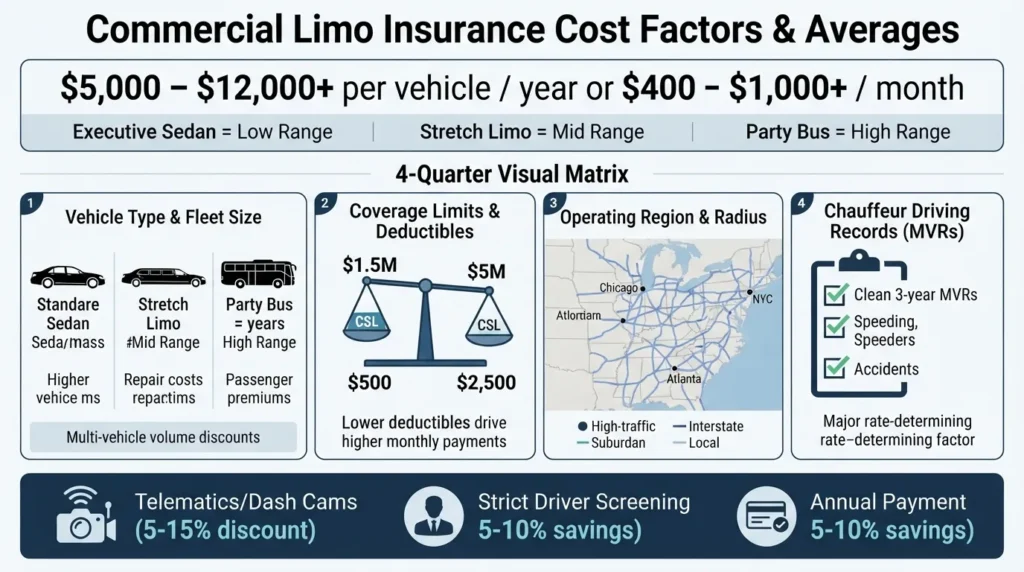
On average, commercial limousine insurance costs between $5,000 and $12,000+ per vehicle per year ($400 to $1,000+ per month per unit). Standard executive sedans sit on the lower end of that range, while stretch limousines and party buses easily cross the upper threshold.
Insurers calculate these premiums by assessing how much risk your fleet presents on the road. Understanding the underlying cost factors helps you anticipate your overhead and find realistic ways to manage premiums.
Core Cost Factors
Vehicle Type and Fleet Size: Larger vehicles carry higher passenger capacity and weight, which increases potential liability in a major accident. Stretch limos, party buses, and high-end luxury SUVs cost significantly more to insure for collision and comprehensive coverage than standard town cars because replacement parts and body repairs are far more expensive. While adding vehicles increases your total premium, larger fleets often qualify for multi-vehicle volume discounts on a per-unit basis.
Coverage Limits and Deductibles: Choosing a $1.5 Million or $5.0 Million Combined Single Limit (CSL) will cost considerably more than carrying a basic $750,000 policy. Similarly, lowering your physical damage deductible from $2,500 down to $500 raises your monthly premium because the insurer assumes more financial responsibility upfront for minor repairs.
Operating Region and Radius: Operating in dense metro areas like New York City, Atlanta, or Chicago results in higher base premiums due to severe traffic congestion, higher accident rates, and litigious legal environments. Additionally, vehicles that cross state lines (interstate) face higher federal regulation minimums and broader geographical risk than local suburban services.
Chauffeur Driving Records (MVRs): Your drivers’ Motor Vehicle Records are one of the heaviest weighted pricing factors. Underwriters pull MVRs for every driver on your policy schedule; hiring chauffeurs with speed violations, at-fault accidents, or recent suspensions will spike your rates or make a driver uninsurable under your commercial policy.
Practical Ways to Reduce Premiums
Enforce Strict Hiring Standards: Screen all chauffeurs for clean three-year MVRs and require mandatory defensive driving certifications.
Install Telematics and Dual Dash Cams: In-vehicle cameras document accidents, prove lack of fault during disputed claims, and often trigger carrier discounts of 5% to 15%.
Pay Annually or Semi-Annually: Most commercial carriers charge processing fees or finance rates for 10-month payment plans, whereas paying upfront can save 5% to 10% overall.
Coverage Requirements by State/Province US & Canada
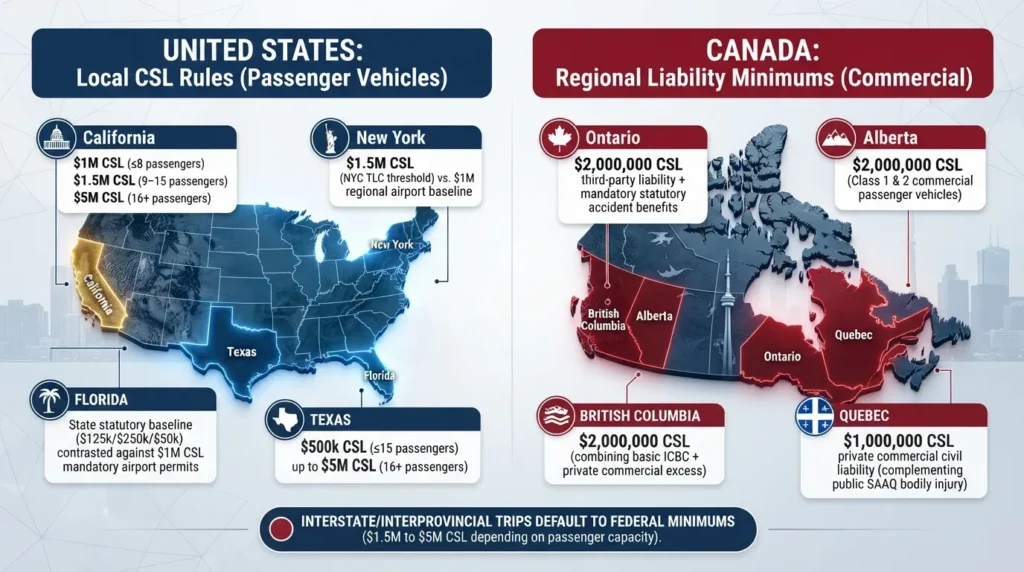
While federal rules govern interstate trips, intrastate and intraprovincial livery operations are regulated by state public utility commissions, provincial transport boards, or local municipal authorities. Operating without meeting your specific region’s minimum liability thresholds can result in immediate permit revocation and severe fines.
California → The California Public Utilities Commission (CPUC) mandates a $1,000,000 CSL for charter-party carriers operating vehicles designed for 8 or fewer passengers, $1,500,000 CSL for 9 to 15 passengers, and $5,000,000 CSL for 16 or more passengers.
New York → The New York City Taxi and Limousine Commission (TLC) requires $1,500,000 CSL for luxury limousines and black cars operating within NYC. Outside NYC, state DMV minimums start lower, but major regional airports require a $1,000,000 CSL permit baseline.
Florida → Florida Statute requires minimum liability limits of $125,000/$250,000/$50,000 for limousines, but major airport authorities (e.g., MIA, MCO) enforce a $1,000,000 CSL minimum before issuing commercial pickup access.
Texas → Municipal licensing authorities (such as Dallas and Houston) and local transportation codes mandate $500,000 CSL for limousines carrying 15 passengers or fewer, jumping to $5,000,000 CSL for vehicles seating 16 or more.
Ontario → Municipal vehicle-for-hire bylaws (including Toronto Chapter 545) require a minimum of $2,000,000 CSL in third-party public liability coverage, alongside mandatory Ontario statutory accident benefits.
Alberta → Alberta Transportation mandates $2,000,000 CSL third-party liability coverage for class 1 and class 2 commercial passenger vehicles, including luxury sedans and stretch limousines.
British Columbia → The Passenger Transportation Board (PTB) requires a minimum of $2,000,000 CSL liability insurance for luxury limousine licensees, combining basic ICBC coverage with private commercial excess policies.
Quebec → The Commission des transports du Québec (CTQ) requires $1,000,000 CSL in private commercial civil liability for passenger transport operations to complement Quebec’s public SAAQ bodily injury system.
What Happens When You File a Claim
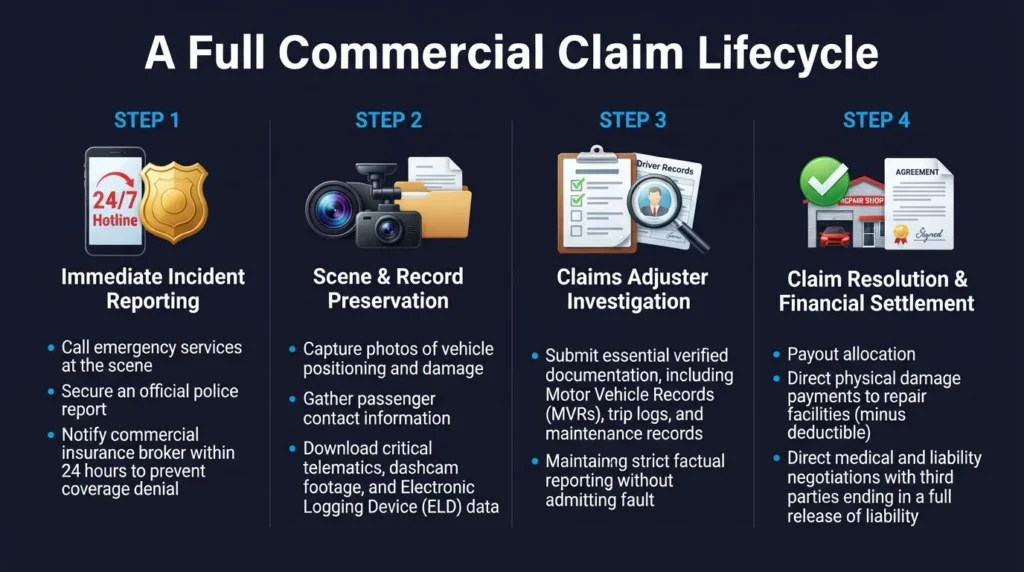
Filing a commercial auto claim for a limousine involves a much more detailed process than a personal car accident claim. Insurance adjusters evaluate passenger safety records, driver logs, and commercial contract terms immediately. Following a structured sequence keeps your business protected and speeds up payout timeline decisions.
1.Report the incident immediately:Notify authorities and your broker within 24 hours.
Call local law enforcement to obtain an official police report at the scene, regardless of how minor the damage appears. Next, report the incident to your commercial insurance broker or insurer’s emergency claims line right away. Most commercial policies require prompt reporting—waiting several days can give underwriters grounds to delay or deny coverage.
2.Document everything at the scene and preserve records:Collect physical evidence and digital data.
Take photos of vehicle positioning, road conditions, license plates, and visual damage to all vehicles involved. Collect full contact and insurance details from other drivers, along with names and phone numbers of passengers in your vehicle. Download and save dashcam footage, GPS tracking logs, and your driver’s electronic logging device (ELD) data for that shift before it gets overwritten.
3.Work directly with the claims adjuster:Provide verified documentation to establish liability.
An assigned commercial claims adjuster will contact you to review the incident details and inspect vehicle damage. Provide them with the driver’s MVR (Motor Vehicle Record), vehicle maintenance logs, trip sheets, and police reports. Avoid admitting fault or making speculative statements during these interviews; stick strictly to verifiable facts.
4.Reach claim resolution and settlement:Vehicle repair, medical settlements, and liability release.
For physical damage, the insurer issues payment to your chosen repair facility minus your comprehensive or collision deductible. For bodily injury claims involving passengers or third parties, the insurer negotiates directly with claimants or their legal counsel to reach a settlement up to your policy limits. Once settled, claimants sign a release of liability preventing further financial demands against your limousine business.
Frequently Asked Questions – Bus from Pearson to London
Federal and state regulations set insurance minimums based on seating capacity, including the driver. Vehicles carrying 15 or fewer passengers typically require at least $1.5 million in CSL liability, while vehicles carrying 16 or more passengers (like stretch limos and party buses) trigger a minimum $5 million federal liability threshold, driving up premium costs.
Yes, many insurers allow operators to suspend physical damage coverage or lower liability limits on seasonal vehicles using a layup endorsement or off-season policy change. However, you must maintain minimum active coverage if local airport permits or municipal licensing authorities require year-round active filings.
Standard primary auto liability does not cover client property. You need Garagekeepers Liability or a specific cargo endorsement to cover lost, stolen, or damaged passenger luggage and personal items stored inside the vehicle or on your property.
If total damages exceed your primary liability coverage, your business must pay the remaining balance out of pocket unless you carry a commercial umbrella or excess liability policy. A single severe multi-passenger injury claim can easily surpass standard limits, putting corporate assets and future revenue at risk.
No. Chauffeur insurance usually refers to specific driver protection or personal liability, whereas commercial limo insurance is a comprehensive policy that covers the vehicle, business entity, third-party bodily injury, passenger injury, and property damage under a primary commercial auto limit.
Explore Airport Topics
Our Services
Featured Travel Guides
Beck Taxi vs Limo Service: Flat Rate Comparison
Winter Limo Service Toronto & GTA
Medical Transportation Limo Toronto
SUV vs Sedan — Airport Luggage Capacity
Hertz Rental Toronto Pearson Airport
Car Seat Sanitization Protocol for Limo Services
View All Travel Guides →Industry & Safety Standards
Our Service Guarantee
Every guide is written from real chauffeur and dispatch experience — flat-rate pricing, licensed vehicles and 24/7 flight-monitored pickups across Toronto & the GTA.
24/7 Quick Response
+1 (647) 654-4915