Why You Should Never Use a Rideshare for Airport Transfers with Infants
If you are stepping off a flight at Toronto Pearson or Billy Bishop with a baby, relying on Uber or Lyft is a major risk. Rideshare apps in Canada do not provide child safety seats, leaving exhausted parents facing last-minute ride cancellations at the curb. Worse, unlike traditional city taxis, rideshare services in Ontario are not exempt from child restraint laws, meaning riding without a proper seat is both illegal and unsafe.
Here is why booking a standard rideshare with an infant usually turns into a travel nightmare:
Zero Equipment Provided: Uber and Lyft drivers across the Greater Toronto Area do not carry infant or convertible car seats in their vehicles.
Immediate Driver Refusals: If you arrive without your own car seat, the driver will cancel your ride on the spot to avoid traffic fines and license demerit points.
Strict Legal Requirements: Under Section 106 of the Ontario Highway Traffic Act, passengers under 8 years old must be properly secured in an appropriate child seat, with no exemption for rideshare vehicles.
Curb Stress and Safety Risks: Attempting to install your own heavy seat in an unfamiliar car while parked in a busy airport pickup lane leads to rushed, improper installations and extra anxiety.
Table of Contents
The Real Reason — Uber & Lyft Don't Carry Car Seats in Canada
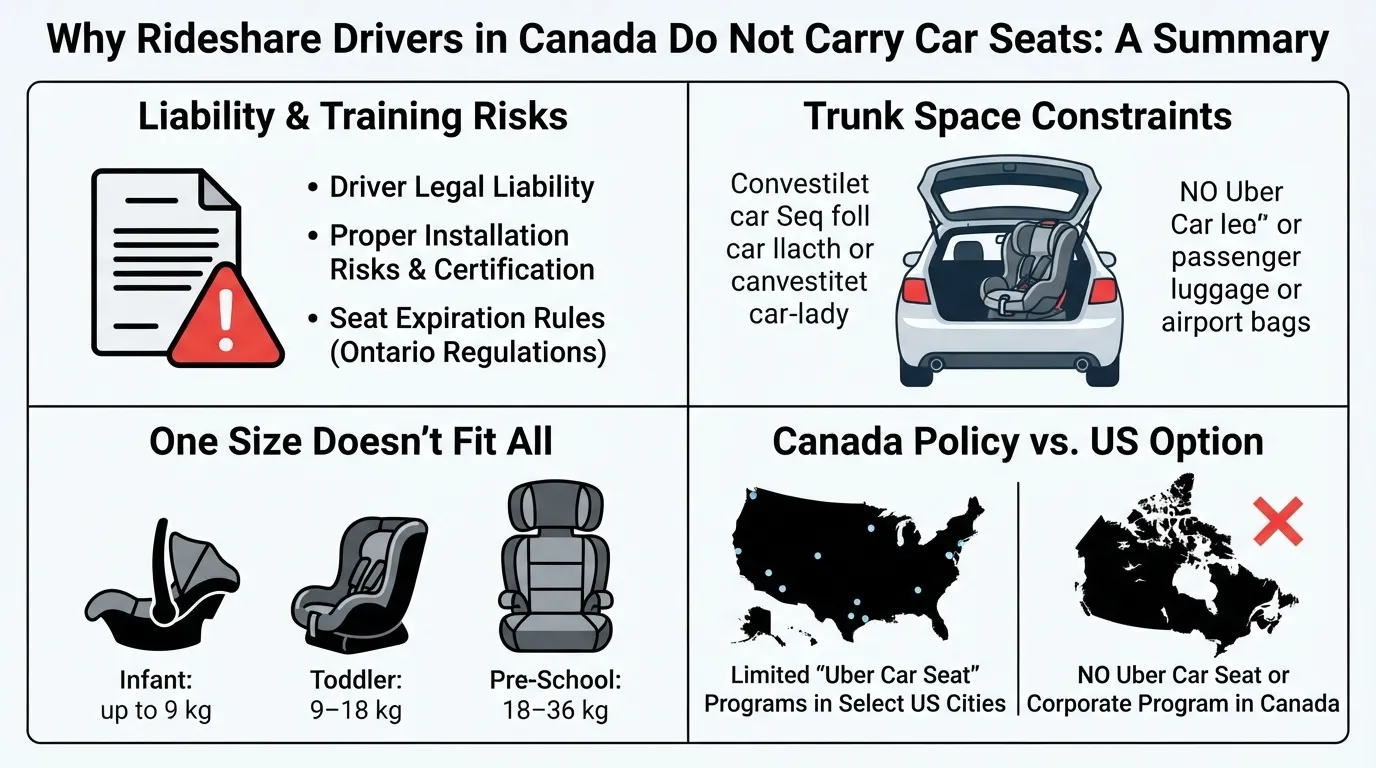
If you’ve browsed parenting forums or Reddit while planning your trip, you’ve likely seen conflicting advice about ordering an Uber or Lyft with a child seat. Here is the direct reality: the Uber Car Seat feature does not exist anywhere in Canada. While ride-hailing platforms run dedicated car seat programs across select major U.S. markets—including New York City, Los Angeles, San Francisco, Orlando, Miami, Atlanta, and Washington, D.C.—those programs have never expanded into Ontario or the rest of Canada.
When landing at Toronto Pearson (YYZ) or Billy Bishop (YTZ), relying on a rideshare app to provide a child restraint leaves you with zero guaranteed options:
Drivers do not carry seats: Drivers are independent contractors who pay for their own equipment, and carrying a bulky seat takes up valuable trunk space needed for luggage.
Trip cancellation is mandatory: Under Ontario law, rideshare drivers are legally subject to traffic violations if they transport a child under eight without a proper seat. A driver will—and legally must—cancel your ride on the spot if you show up without one.
Cancellation fees apply to you: Because drivers aren’t required to provide equipment, arriving at the pickup curb without an appropriate car seat counts as a passenger-side issue, leaving you stranded with a cancellation fee.
Legal ≠ Safe — Ontario's Car Seat Exemption Explained
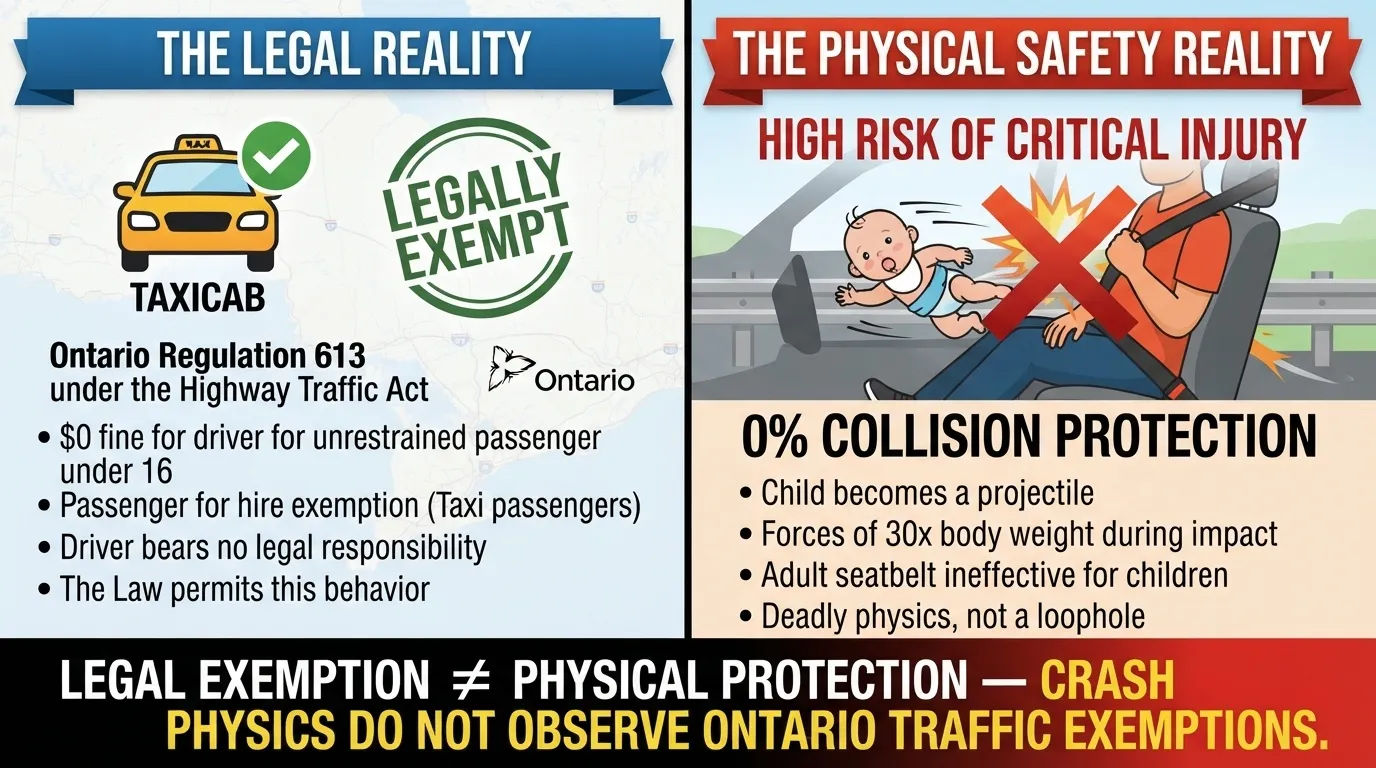
Many parents arriving at Toronto Pearson or Billy Bishop are surprised to learn that Ontario law treats taxis and rideshares very differently when it comes to child safety. Under Ontario Regulation 613, Section 8.1, drivers of licensed taxicabs and limousines transporting passengers for hire are legally exempt from providing or requiring child car seats.
However, “legal” does not mean safe, nor does it mean rideshare drivers enjoy the exact same pass.
Why the Exemption Is a Dangerous Trap for Families
Rideshare’s Legal Grey Area: Private Transportation Company (PTC) drivers for Uber or Lyft operate personal vehicles. Because they are not traditional taxicabs, the Regulation 613 exemption is legally ambiguous for rideshare apps. Drivers risk a $240 fine and 2 demerit points under the Ontario Highway Traffic Act if they transport an unrestrained child, which is why most Toronto rideshare drivers will cancel your ride on the spot if you show up without a car seat.
The “Lap Holding” Myth: A common belief among travelers is that holding an infant tightly on your lap in the back of a taxi is a safe alternative. In a 50 km/h collision, a 10-pound infant experiences forces that turn their body weight into roughly 300 pounds of forward momentum. It is physically impossible for a parent to hold onto a baby during an impact.
The Safety Reality: According to Transport Canada, using a properly installed, age-appropriate car seat reduces the risk of infant crash fatalities by 71% and serious injuries by 67%.
The Ontario taxi exemption was created as an operational shortcut for city cab drivers—not as a standard for child safety. While a street taxi can legally pull away with your baby unrestrained, doing so puts your child at extreme risk on busy GTA highways like the 401 or QEW. Pre-booking a private airport transfer with a guaranteed, sanitized car seat ensures your baby gets full crash protection from the moment you leave the terminal.
What Happens If You Show Up Without a Car Seat
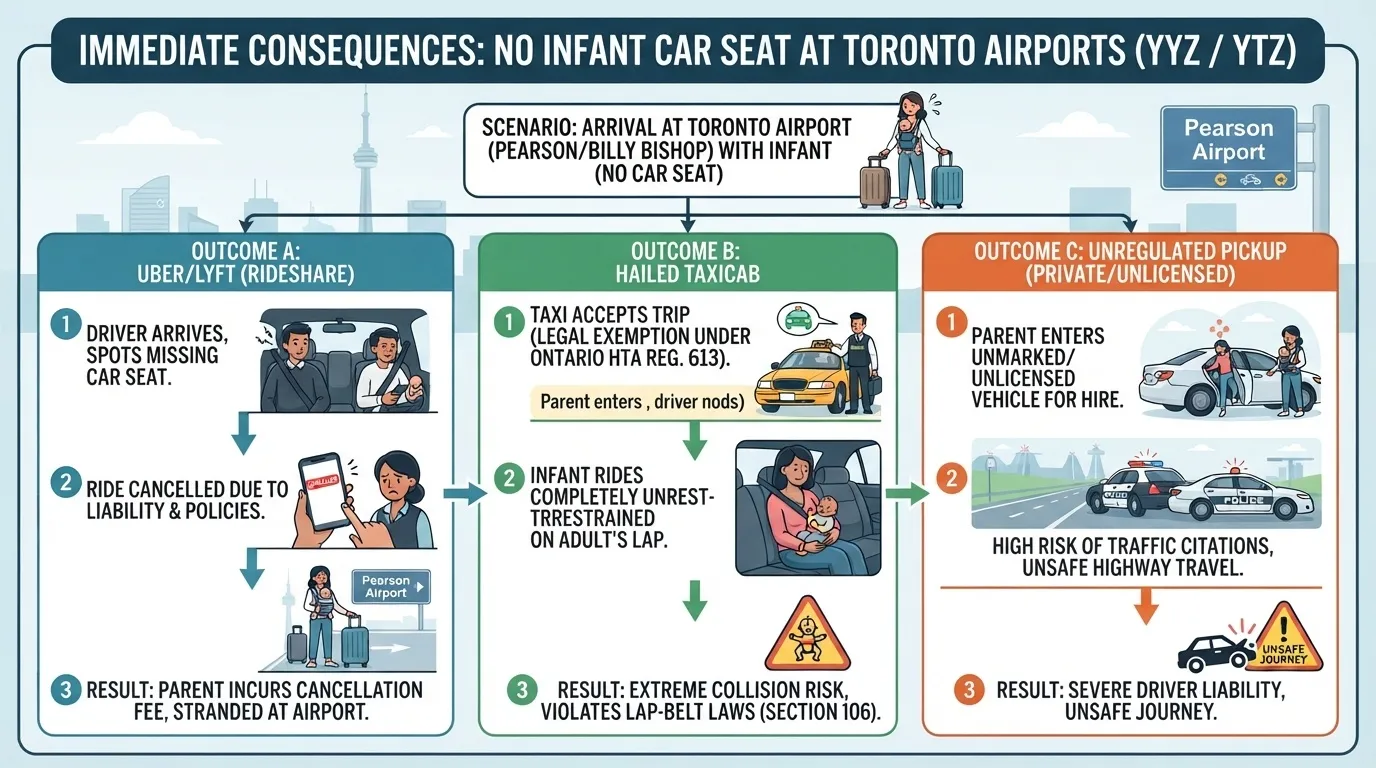
If you land at Pearson or Billy Bishop expecting to request an Uber or Lyft and figure out the infant seat when the car pulls up, you are setting yourself up for an immediate roadblock. Under Ontario’s Highway Traffic Act, private rideshare drivers—unlike traditional taxicabs—are not exempt from child restraint laws. If you do not have a car seat with you, the driver is legally required to deny the ride.
The Double Hit: Immediate Cancellation & Surge Pricing
When a rideshare driver cancels because there is no car seat, you pay for it in both time and money.
The Immediate Cancellation: The driver will mark you as a no-show or safety cancellation at the curb. You are left standing at the pickup area with your luggage, a stroller, and an overtired baby.
Surge Pricing Penalty: Re-booking on the spot forces you back into the dispatch queue. If Terminal 1 or Terminal 3 is busy, dynamic surge pricing will likely kick in, doubling the cost of your second attempt while you wait another 15 to 20 minutes on the curb.
The Installation Gap: Curb Stress Under Pressure
Even if you bring your own car seat, using standard rideshare turns the airport curb into a high-stress trial.
Race Against the Clock: Uber and Lyft drivers face strict airport dwell-time limits and immediate cancellation timers. They are focused on getting moving quickly, not on assisting you with installation.
The Curb Struggle: You will be left kneeling on the concrete at a crowded Pearson pickup zone, wrestling with Universal Anchor System (UAS) lower anchors or threaded seatbelts while traffic whizzes past.
Fit Compatibility Issues: Every vehicle’s seat angle and anchor depth differ. Attempting to get a secure, tight install under 2.5 cm (1 inch) of movement while your baby is crying and the driver is watching the clock is a recipe for errors.
Billy Bishop (YTZ) vs Pearson (YYZ) — What Families Actually Face
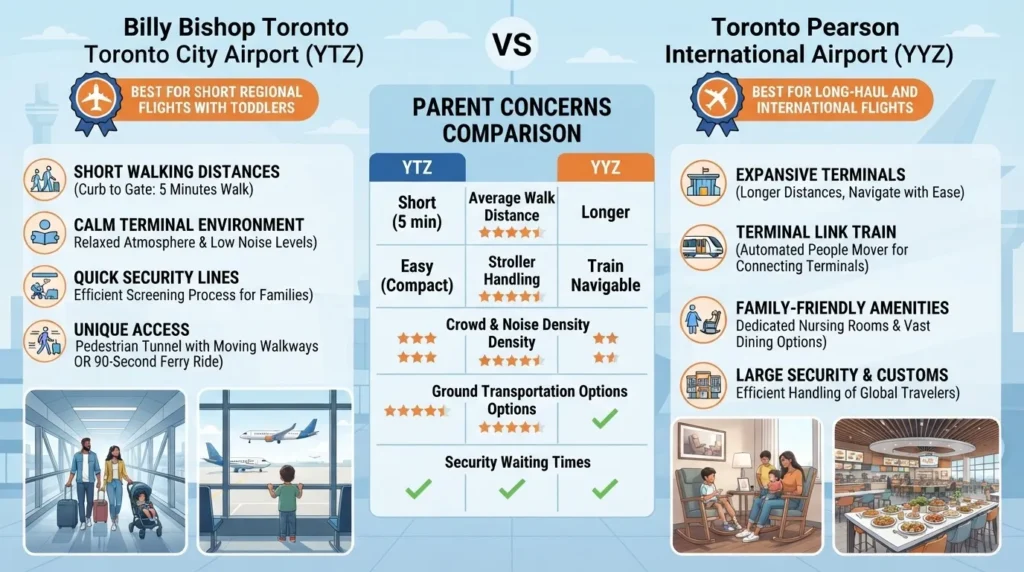
Navigating a Toronto airport with a baby is entirely different depending on where your flight touches down. Pearson International and Billy Bishop City Airport handle ground transit differently, presenting distinct physical and logistical challenges for parents traveling with young children.
Billy Bishop (YTZ): Island Transit and Shuttle Limitations
Billy Bishop’s unique island location adds extra transfer steps before you ever reach a city street.
The Free Downtown Shuttle: While the complimentary shuttle connects the mainland passenger terminal to Union Station every 15 minutes, it operates like a standard city transit bus. It does not carry or provide infant car seats, and holding a lap-child on a moving shuttle in downtown traffic carries inherent safety risks.
Lack of On-Site Rideshare Car Seats: On-demand rideshares picking up on the mainland side rarely carry proper child restraints. If you order an Uber or Lyft upon arrival without bringing your own car seat, drivers will cancel the ride on the spot to avoid Highway Traffic Act violations.
Pedestrian Tunnel Drag: Hauling an infant, a heavy convertible car seat, and checked luggage through the 260-metre pedestrian tunnel or onto the ferry creates immediate physical strain for solo parents or tired families.
Pearson International (YYZ): Navigating the Megastructure
Pearson’s sheer scale creates a different problem: navigating designated pickup curbs with heavy gear while managing a fussy baby.
Designated Pickup Pillars: Standard rideshares cannot pick you up at the regular arrivals curb. You must trek to specific ground-level doors—Terminal 1 (Door Q/R/S at Zones 4 and 5) or Terminal 3 (Doors B/D at Zones 3–6).
Pre-Arranged Pickup Zones: Licensed pre-arranged vehicles (like reserved private car services) pick up at separate designated areas (Door A at both Terminal 1 and Terminal 3).
The Long Walk Challenge: If you call an on-demand rideshare after landing, you face a 10- to 15-minute walk through the terminal while carrying your child and luggage, only to risk a driver cancelling if your equipment doesn’t fit or isn’t installed.
Practical Advice: Why Advance Arrangements Are Non-Negotiable
At both airports, relying on on-demand ground transit with an infant is a gamble that rarely pays off.
Securing your vehicle arrangement before your flight leaves the ground eliminates curb-side surge pricing, long terminal walks, and driver cancellations. Booking a dedicated transfer service in advance guarantees that a vehicle with the correct, pre-installed car seat is already parked at the designated pillar or mainland curb the moment your family steps out of baggage
The Hidden Winter Risk
Bulky Coats and Harness Slack
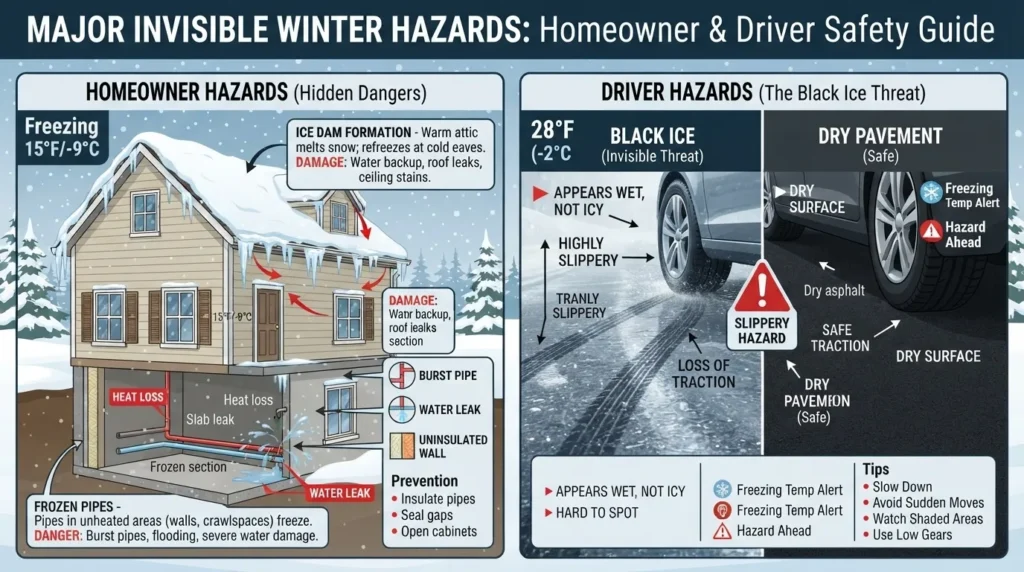
Canadian winters introduce a silent hazard that catches many traveling parents off guard: dressing an infant or toddler in a puffy snowsuit before strapping them into a car seat. In a sudden stop or crash, the heavy padding of a winter coat instantly compresses under the force, leaving wide gaps of slack in the harness straps. This hidden looseness can cause severe injury or allow a child to slip out of the restraint entirely.
Ditch the heavy outerwear: Dress your baby in thin, warm layers (like fleece) before buckling them into the harness.
The pinch test: Pinch the harness strap at your child’s shoulder; if you can grab any webbing between your fingers, the harness is too loose.
Layer over the harness: Tuck a warm blanket or drape their winter coat backwards over them after the harness is snugly clicked in.
Taxi vs Uber/Lyft vs Professional Car Seat Service — Quick Comparison
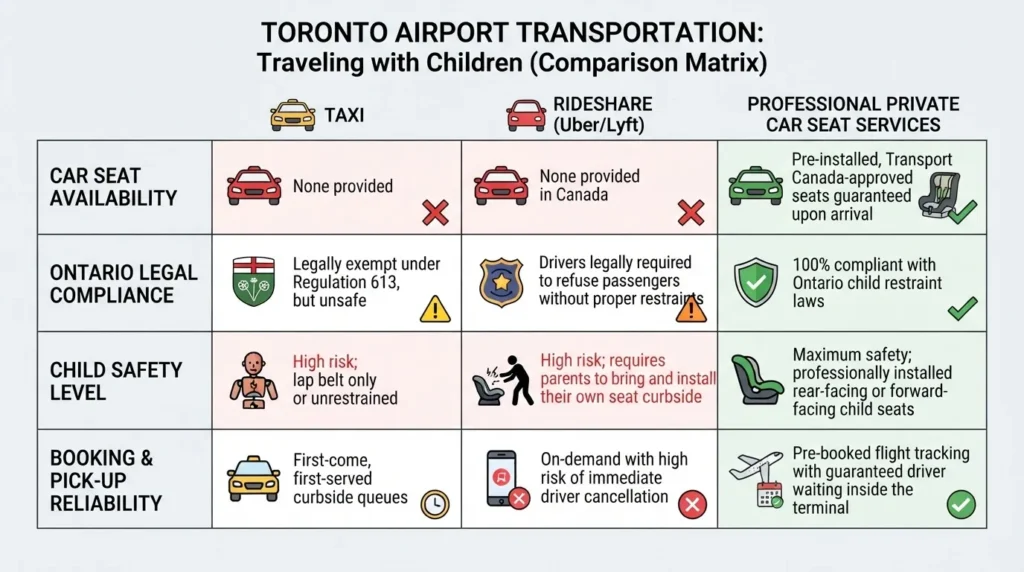
| Feature | Taxi | Uber / Lyft | Professional Car Seat Service |
|---|---|---|---|
| Car Seat Law Exemption | Yes (Reg 613) | Unclear / No | N/A — Provided anyway |
| Car Seat Available | Rarely | Not in Canada | Guaranteed, pre-installed |
| Cancellation Risk | Low | High | None |
| Pricing | Metered | Surge | Fixed flat rate |
Key Takeaways for Airport Transfers
Taxis offer legal loopholes, not physical protection: Ontario Regulation 613 exempts licensed taxis from carrying car seats, but standard seatbelts cannot protect an infant or toddler during a collision.
Rideshares come with high cancellation risks: Neither Uber nor Lyft provides child car seats in Canada, meaning drivers can legally cancel your ride at the curb if you do not bring your own seat.
Professional car services guarantee compliance and peace of mind: Pre-booking a dedicated airport service ensures an age-appropriate, sanitized seat is correctly installed before your flight arrives at Pearson or Billy Bishop.
Frequently Asked Questions
Yes. Under Regulation 613 of Ontario’s Highway Traffic Act, licensed taxicabs transporting passengers for hire are legally exempt from child seat requirements. However, legal does not mean safe—a standard seatbelt cannot secure a baby, leaving them completely unprotected in a collision.
No. Neither Uber nor Lyft offers a car seat option anywhere in Canada. Because rideshares operate under private vehicle rules, drivers are legally required to ensure young children are in appropriate restraints and can refuse your ride on the spot if you show up without a seat.
No. Holding a baby on your lap or sharing a seatbelt is illegal under Section 106 of Ontario’s Highway Traffic Act, which enforces a strict one-person-per-seatbelt rule across all vehicles. In a sudden stop or crash, an unrestrained child can be thrown forward or crushed by the adult’s body weight.
The safest choice is pre-booking a private airport transfer that supplies and pre-installs a Transport Canada–approved rear-facing car seat. If you are traveling light, another safe alternative is taking the airport pedestrian tunnel or ferry to catch the TTC streetcar, as public transit vehicles operate without car seat requirements.
Yes. On-demand taxis hailed at airport curbs and rideshare vehicles do not carry extra car seats in their trunks. Pre-booking through a dedicated family transfer service is the only reliable way to ensure an age- and weight-appropriate seat is sanitized, correctly installed, and ready when your flight lands.