Short-Haul Ontario Routes: Flight Times from Toronto to Chicago, Newfoundland & Ottawa
- Home
- Blog
- Billy Bishop Airport
- Short-Haul Ontario Routes
Direct flights from Toronto to major regional business and leisure hubs range from a quick 55 minutes to just under three and a half hours. Depending on whether you depart from Toronto Pearson International Airport (YYZ) or Billy Bishop Toronto City Centre Airport (YTZ), your actual time in the air stays under the 4-hour mark for all of eastern Canada and the US Midwest.
The table below breaks down the typical non-stop flight durations, distances, and primary destination airports for these popular routes.
| Destination | Flight Time Range | Distance | Primary Airport(s) |
|---|---|---|---|
| Chicago | 1h 55m – 2h 15m | 437 miles (703 km) | O'Hare International (ORD), Midway (MDW) |
| Newfoundland | 3h 05m – 3h 24m | 1,326 miles (2,134 km) | St. John's International (YYT) |
| Ottawa | 0h 55m – 1h 15m | 227 miles (365 km) | Macdonald-Cartier International (YOW) |
Chicago
| Flight Time | 1h 55m – 2h 15m |
| Distance | 437 miles (703 km) |
| Airports | O'Hare International (ORD), Midway (MDW) |
Newfoundland
| Flight Time | 3h 05m – 3h 24m |
| Distance | 1,326 miles (2,134 km) |
| Airports | St. John's International (YYT) |
Ottawa
| Flight Time | 0h 55m – 1h 15m |
| Distance | 227 miles (365 km) |
| Airports | Macdonald-Cartier International (YOW) |
Flying out of the island airport (YTZ) on a turboprop like a Porter De Havilland Dash 8-Q400 generally shaves a few minutes off the Ottawa run compared to a larger mainline jet sitting in a departure queue at Pearson. For Chicago travel, remember that O’Hare sits in the Central Time Zone, meaning you gain an hour on the way into Illinois but lose it heading eastbound back to Ontario.
Last updated: July 2026
Table of Contents
Toronto to Chicago Flight Time
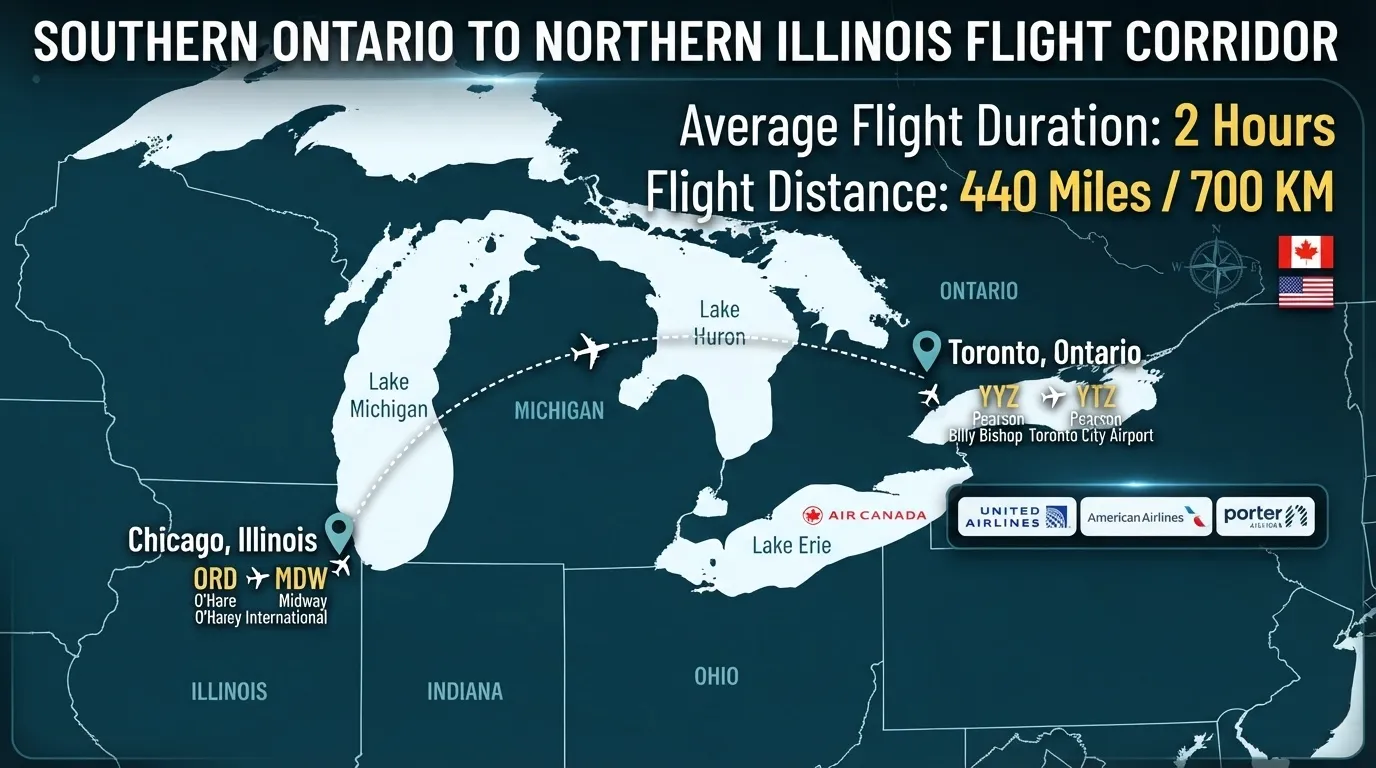
A non-stop flight from Toronto to Chicago typically takes around 2 hours. | Route | Departure Airport | Arrival Airport | Average Flight Duration | Distance |
| :— | :— | :— | :— | :— |
| YYZ → ORD | Toronto Pearson (YYZ) | Chicago O’Hare (ORD) | 2 hours, 15 minutes | 437 miles (703 km) |
| YTZ → MDW | Billy Bishop (YTZ) | Chicago Midway (MDW) | 1 hour, 50 minutes | 441 miles (710 km) |
Yes, direct flights are widely available between both cities. Major commercial carriers like Air Canada, United Airlines, and American Airlines service the busy corridor from Toronto Pearson (YYZ) to Chicago O’Hare (ORD). If you prefer flying out of downtown Toronto, Porter Airlines provides frequent direct services from Billy Bishop Airport (YTZ) over to Chicago Midway (MDW).
Airlines frequently deploy regional jets like the Embraer E175 or Bombardier CRJ series on this short-haul route, alongside Porter’s turboprops. These smaller aircraft get the job done quickly, though you might feel a few more bumps during minor turbulence compared to a large widebody jet.
Don’t forget to adjust your watch before landing, as Chicago is 1 hour behind Toronto. Factoring in this time zone shift makes managing your post-flight schedule straightforward.
Toronto to Newfoundland Flight Time

The average direct flight time from Toronto to Newfoundland is 3 hours and 10 minutes. Your exact travel time depends heavily on which part of the island you are visiting, as destination airports sit hundreds of kilometres apart.
| Origin Airport | Destination Airport | Flight Distance | Typical Flight Duration |
|---|---|---|---|
| Toronto Pearson (YYZ) | St. John's (YYT) | 2,121 km (1,318 miles) | 3h 05m – 3h 15m |
| Toronto Pearson (YYZ) | Gander (YQX) | 1,935 km (1,202 miles) | 4h 30m+ (Connecting) |
Most travellers head to St. John’s International Airport (YYT) on the eastern coast. However, if you are heading to central Newfoundland via Gander International Airport (YQX), you will generally look at longer travel times due to layovers.
Direct, nonstop flights are regularly available from Toronto to St. John’s via Air Canada, Porter Airlines, and WestJet, whereas routes to Gander typically require a connection in Halifax or Montreal.
Flight Routes
Keep an eye on the clock when finalizing your itinerary. Newfoundland operates on its own unique time zone, which is 1.5 hours ahead of Toronto (Eastern Time). This means losing a bit of your afternoon on the way out, but gaining it right back on the return leg to Ontario.
Toronto to Ottawa Flight Time
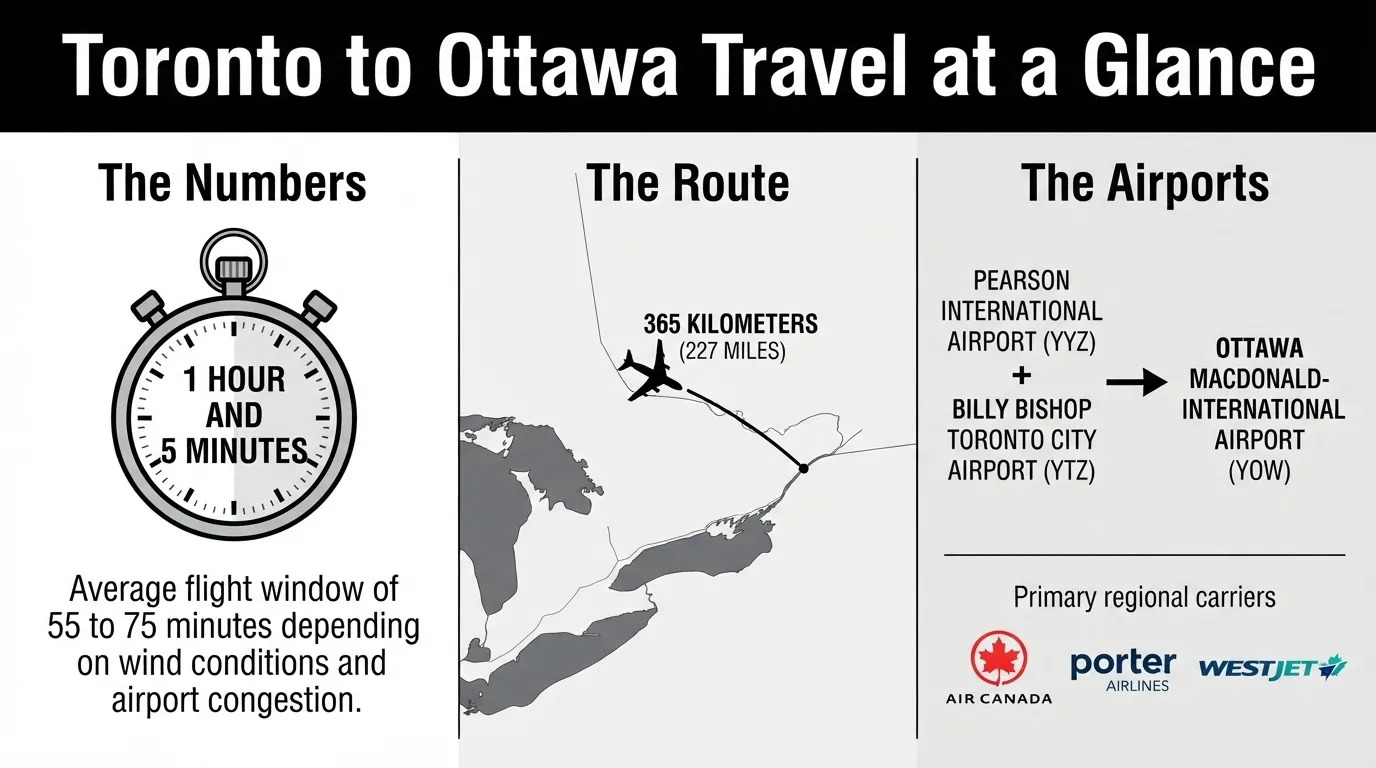
A direct flight from Toronto to Ottawa takes between 55 minutes and 1 hour and 15 minutes of actual air time.
| Route Dimensions | Details |
| Flight Distance | ~350 km (217 miles) |
| Origin Airports | Toronto Pearson (YYZ), Billy Bishop Toronto City (YTZ) |
| Destination Airport | Ottawa Macdonald-Cartier International (YOW) |
Choosing your airport depends entirely on your location and preference. Flying out of Billy Bishop (YTZ) on a Porter Airlines or Air Canada turboprop (like the De Havilland Dash 8-400) usually clocks a brisk 55-minute flight. Jet service from Pearson (YYZ) via Air Canada or WestJet takes slightly longer—roughly 1 hour and 15 minutes—due to more complex runway taxiing and larger airspace patterns. Fortunately, you will not have to worry about jet lag; both cities operate on Eastern Time.
Is Flying Actually Faster? — Door-to-Door Reality Check
While an hour in the air sounds incredibly fast, the total travel time involves airport security, check-in windows, and commuting to the terminal.
| Travel Method | In-Transit Time | Total Door-to-Door Time |
| Flight (from YTZ) | ~55 mins | ~3 hours |
| Flight (from YYZ) | ~1h 15m | ~3.5 hours |
| VIA Rail Train | ~4.5 hours | ~5 hours |
| Driving | ~4.5 hours | ~4.5 hours |
Compare All Three Routes at a Glance
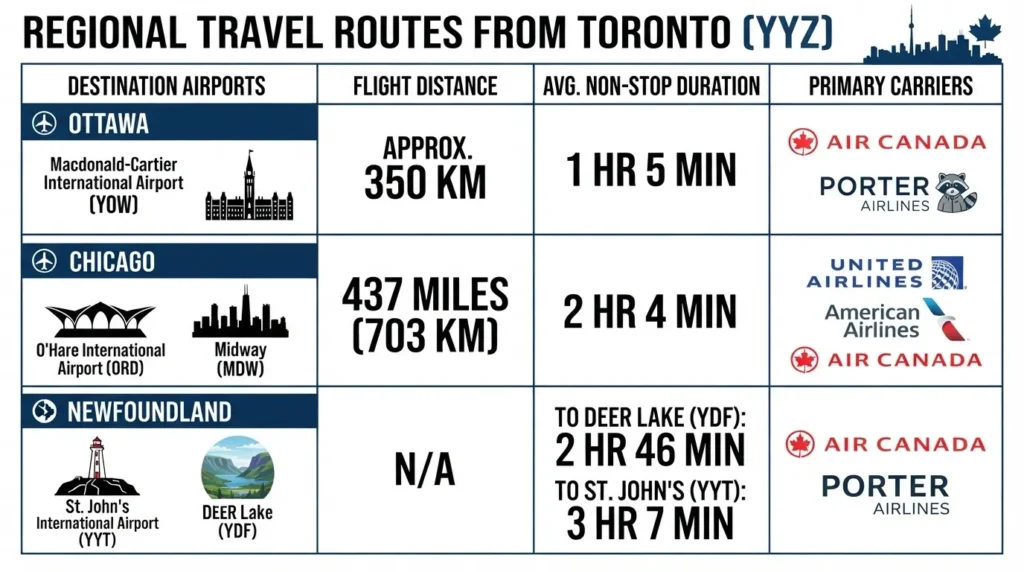
Comparing Toronto’s primary short-haul routes side-by-side reveals significant differences in travel times, time zones, and distances depending on whether you head east, west, or stay within Ontario. While a hop over to Ottawa is a quick intra-provincial flight, heading out to Newfoundland or across the US border to Chicago introduces distinct logistical shifts.
For instance, flying into Chicago requires clearing US Customs and Border Protection, which you can conveniently do right inside Toronto Pearson (YYZ) before your departure. On the flip side, traveling to St. John’s, Newfoundland pushes you into Canada’s easternmost, unique half-hour time zone, making the clock jump ahead by 90 minutes.
The table below breaks down the essential baseline metrics for all three non-stop regional flight paths departing from Toronto:
| Route | Distance | Flight Time | Time Zone Diff | Main Airports |
|---|---|---|---|---|
| Toronto → Chicago | ~435 miles (700 km) | ~2 hours | -1 hour (CST) | YYZ, YTZ → ORD, MDW |
| Toronto → Newfoundland | ~1,326 miles (2,134 km) | ~3 hours, 10 mins | +1.5 hours (NST) | YYZ → YYT (St. John's) |
| Toronto → Ottawa | ~225 miles (360 km) | ~1 hour | 0 (EST) | YYZ, YTZ → YOW |
Toronto → Chicago
| Distance | ~435 miles (700 km) |
| Flight Time | ~2 hours |
| Time Zone Diff | -1 hour (CST) |
| Main Airports | YYZ, YTZ → ORD, MDW |
Toronto → Newfoundland
| Distance | ~1,326 miles (2,134 km) |
| Flight Time | ~3 hours, 10 mins |
| Time Zone Diff | +1.5 hours (NST) |
| Main Airports | YYZ → YYT (St. John's) |
Toronto → Ottawa
| Distance | ~225 miles (360 km) |
| Flight Time | ~1 hour |
| Time Zone Diff | 0 (EST) |
| Main Airports | YYZ, YTZ → YOW |
Frequently Asked Questions
Short-haul flights feel bumpier primarily because regional jets fly at lower altitudes where the air is denser and more susceptible to weather. On a quick run from Toronto (YYZ) to Ottawa (YOW), aircraft usually cruise between 15,000 and 24,000 feet. At this height, planes frequently encounter thermal currents, ground-level wind shear, and cloud formations that long-haul widebodies simply fly over at 38,000 feet. Smaller aircraft like the De Havilland Dash 8-400 also react more noticeably to these atmospheric shifts than massive international jets.
Yes, flight times vary by up to 20 minutes depending on seasonal jet streams and airline schedule padding. Strong winter headwinds blowing from west to east mean a flight from Toronto to Chicago O'Hare (ORD) takes longer than the return trip. Airlines also deliberately pad their posted schedules for peak travel seasons to protect their on-time performance ratings against runway congestion.
The Toronto to Chicago corridor sees the highest volume, with over 15 direct daily flights. Major network carriers like Air Canada, United Airlines, and American Airlines operate continuous hourly service between YYZ and ORD to feed their respective hubs.
No, adding a connection on short-haul Ontario regional routes rarely saves money and drastically extends travel times. Layovers in Montreal or Newark routinely turn a straightforward 90-minute hop into a grueling five-hour ordeal without offering any meaningful discount on regional fare structures.
Explore Airport Topics
Our Services
Featured Travel Guides
Billy Bishop Airport Limo Cost
Billy Bishop to Pearson Airport Transfer Guide
Hertz Rental Toronto Pearson Airport
Medical Transportation Limo Toronto
Car Seat Sanitization Protocol for Limo Services
Winter Limo Service Toronto & GTA
View All Travel Guides →Industry & Safety Standards
Our Service Guarantee
Every guide is written from real chauffeur and dispatch experience — flat-rate pricing, licensed vehicles and 24/7 flight-monitored pickups across Toronto & the GTA.
24/7 Quick Response
+1 (647) 654-4915