Corporate Car Service vs Rideshare for Business Travel: Which One Should You Book?
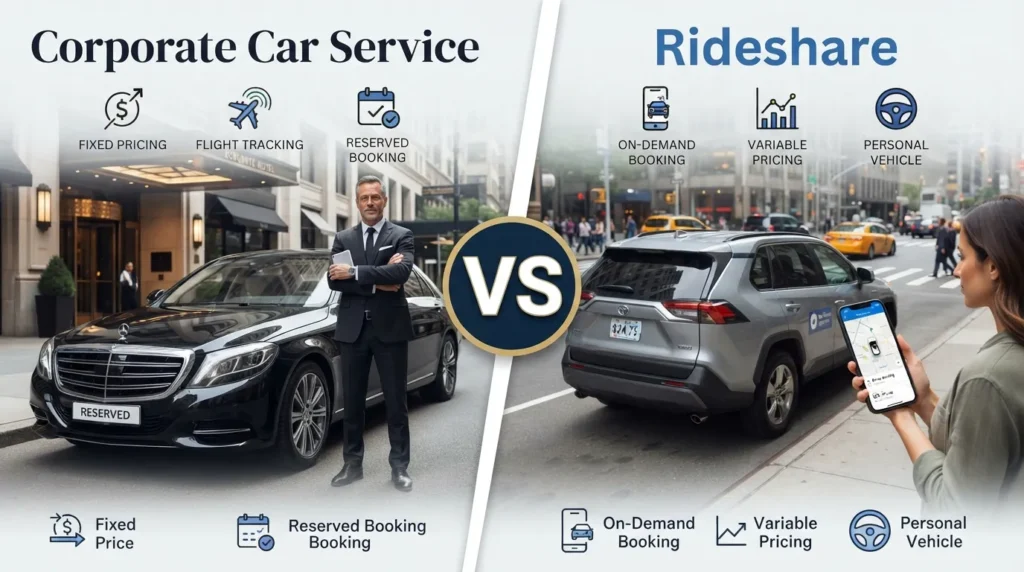
If you’re booking travel for an executive, a client visit, or an airport transfer, the honest answer is this: rideshare wins on price for quick, low-stakes city trips, but a corporate car service wins almost every time your trip involves a client, an important flight, or your company’s reputation. The two aren’t really competing for the same job — they’re built for different situations, and once you see where each one actually fits, the decision becomes easy.
Below, I’ll walk you through exactly how they compare on cost, reliability, presentation, and expense management, then give you a simple way to decide which one makes sense for your next business trip.
Corporate Car Service vs. Rideshare: The Quick Comparison
Before we get into the details, here’s how the two options stack up on the factors that actually matter for business travel.
| Factor | Rideshare | Corporate Car Service |
|---|---|---|
| Pricing | Variable, rises sharply with demand (surge) | Flat, pre-agreed rate — no surprises |
| Booking model | On-demand, algorithm-matched driver | Reserved in advance for a specific window |
| Flight delay handling | Not tracked — you re-request manually | Flight tracked, pickup adjusted automatically |
| Vehicle standard | Personal vehicle, varies by driver | Professionally maintained, business-grade fleet |
| Driver standard | Independent contractor, basic screening | Trained chauffeur, grooming and etiquette standards |
| Insurance / liability | Personal auto policy plus platform coverage | Commercial-grade liability coverage |
| Expense management | Individual receipts per ride, self-managed | Centralized monthly billing, one invoice |
Cost and Convenience: Why the Cheaper Option Isn’t Always Cheaper
For a short, everyday trip across town, rideshare is usually the lower-cost option — that part is true. The problem is that the price you see when you open the app isn’t necessarily the price you’ll pay when you actually need the ride. Surge pricing kicks in during rush hour, bad weather, major events, and flight-heavy periods at the airport, which happens to be exactly when business travellers need a car most. A trip that looks affordable at 2 p.m. can cost noticeably more at 6 p.m. on a Friday.
A corporate car service works the opposite way. You agree on a flat rate — often a fixed fee for an airport transfer — before the trip happens, so there’s no dynamic pricing to track, explain, or approve after the fact. For a single occasional trip, that difference might not matter much. For a company booking transportation regularly, predictable pricing turns into real savings on admin time alone, since nobody has to reconcile a surge charge on an expense report.
Reliability and Scheduling: What Happens When a Flight Runs Late
This is where the two services diverge the most, and it’s usually the deciding factor for business travel.
Rideshare runs on an on-demand, algorithmic model. You request a car when you’re ready, and a nearby driver is matched to you. During busy periods, that also means a driver can cancel on you, leave you waiting curbside longer than expected, or simply not be available at all near a terminal during a rush. There’s no one holding a spot for you specifically — you’re back in the queue with everyone else.
A corporate car service is reservation-based. Your vehicle and driver are booked for your specific arrival window, not summoned in the moment. Most professional services also track your flight in real time, so if your flight lands late, your driver adjusts the pickup automatically instead of you sitting there wondering if anyone is coming. For a client meeting or a tight connection, that difference between “hoping a driver shows up” and “knowing one is already assigned” is the whole point of paying more.
Duty of Care and Presentation: The Part Most Comparisons Skip
This is the section most rideshare-vs-limo comparisons gloss over, but for a company sending someone to represent it, it’s arguably the most important one.
With rideshare, you’re getting a driver’s personal vehicle, and that vehicle can be anything — a clean late-model sedan or an older subcompact with fast food wrappers in the door pocket. Screening is basic and standardized across the platform, not tailored to a business context. If you’re picking up a client or a visiting executive, you’re taking a gamble on what shows up.
Corporate chauffeurs are trained to a business etiquette standard — grooming, punctuality, discretion, and professional conduct are part of the job, not a matter of luck. Vehicles are unmarked, professionally maintained, and kept to a consistent standard, because the vehicle itself is part of how your company is presented. Corporate car services also typically carry higher commercial-grade liability insurance than an individual rideshare driver’s personal policy, which matters if your company has a formal duty-of-care policy covering how employees and clients are transported.
Expense Management: One Invoice vs. a Stack of Receipts
If one employee takes an occasional rideshare, tracking the cost is simple — it’s one receipt through an app. The friction shows up at scale. When a company has multiple travellers taking regular rides, someone has to collect, categorize, and approve each individual fare, and surge-priced trips often need an extra explanation before finance will approve them. Some rideshare platforms offer business profiles that forward receipts automatically, which helps, but you’re still managing many small transactions.
A corporate car service typically consolidates everything into centralized billing — one itemized monthly invoice covering every trip, with a dedicated dispatcher you can actually call if something needs to change. For an executive assistant or office manager coordinating travel for a team, that’s the difference between reviewing one invoice a month and reconciling dozens of individual charges.
A Realistic Scenario: Picking Up a Visiting Client
Say your company is hosting a client flying in for a same-day meeting. If you book a rideshare, you’re relying on whichever driver and vehicle the app assigns at that moment, with no guarantee the driver is watching for flight delays. If the flight lands early or late, you’re the one adjusting the request in real time — and if it’s a busy period at the airport, you may be paying surge pricing on top of the uncertainty.
Book a corporate car instead, and the chauffeur is already tracking the flight number, waiting with a name sign at arrivals, and ready regardless of whether the flight is early or delayed. Your client’s first impression of your company starts in that car — a small detail, but one that’s hard to leave to chance when it’s a relationship you’re trying to build.
So Which One Should You Actually Book?
Rather than picking one option for every trip, most companies get better results using both, depending on the situation.
Choose rideshare if:
- The trip is short, low-stakes, and happening solo (no client or executive involved)
- You need something immediately and flexibility matters more than certainty
- Budget is the top priority and occasional variability in price is acceptable
Choose a corporate car service if:
- You’re picking up or transporting a client, executive, or important guest
- The trip involves a flight, especially one that could be delayed
- Reliability and presentation matter more than shaving a few dollars off the fare
- You need predictable costs and simplified billing across multiple trips or travellers
Corporate Car Service Across Ontario and the GTA
Availability and pricing for both options vary by region. In major hubs across the Greater Toronto Area, both rideshare and corporate car services are widely available, but corporate coverage tends to be more consistent for airport routes, since dedicated fleets are positioned around flight schedules rather than general rider demand. We provide corporate limo service in Toronto, along with dedicated service across Mississauga, Markham, Oakville, and Hamilton, so a chauffeur is assigned locally rather than dispatched from across the city.
If you want a clearer sense of what a flat-rate corporate transfer actually costs before you book, our Toronto airport limo rates page breaks down pricing by route so there’s no guesswork involved.
Frequently Asked Questions
What does “black car service” mean?
Black car service refers to a professional, pre-booked chauffeur service using a high-end vehicle — typically a black sedan or SUV — as opposed to a rideshare or metered taxi. It’s reservation-based, comes with a trained driver, and is generally priced as a flat fee rather than a metered or surge-based fare.
What’s a cheaper alternative to Uber for business travel?
For a single, low-priority trip, comparing rideshare apps against each other before booking can help you find the lowest fare. But if you’re trying to avoid surge pricing altogether rather than just find a slightly cheaper version of it, a flat-rate corporate car service is often the more predictable option, since the price is fixed regardless of demand at the time of your trip.
Why would someone choose a car service over Uber?
The main reasons are reliability, presentation, and accountability. A reserved car service guarantees a vehicle and driver for a specific time window, tracks flights automatically, and holds drivers to professional standards — none of which rideshare is designed to guarantee, since it matches whichever nearby driver happens to be available.
What are the disadvantages of using rideshare apps for business travel?
The main drawbacks are unpredictable pricing during peak demand, inconsistent vehicle and driver quality since it depends entirely on personal vehicles, no guaranteed booking window, and no automatic adjustment for flight delays. For routine personal trips these trade-offs are usually minor, but for client-facing or time-sensitive business travel, they can create real risk.
Is booking rideshare worth it for business travel?
It depends on the trip. For quick, low-stakes travel where cost matters more than certainty, rideshare is a reasonable and convenient choice. For client meetings, executive transport, or any trip where a missed pickup or a mismatched vehicle would reflect poorly on your company, a reserved corporate car service is generally the safer choice.
Need a reliable corporate car for your next client pickup or executive transfer?
For more comparisons and travel planning guides, visit our blog.
Explore Airport Topics
Our Services
Featured Travel Guides
Industry & Safety Standards
Our Service Guarantee
Every guide is written from real chauffeur and dispatch experience — flat-rate pricing, licensed vehicles and 24/7 flight-monitored pickups across Toronto & the GTA.