What to Expect From a Prom Limousine Service
When you book a prom limousine service, you are securing a professional driver, a fully insured luxury vehicle, a fixed time package, and a strict commitment to passenger safety from pickup to drop-off. It is not just hiring a car; it is a structured, end-to-end transport service designed to keep teenagers safe while giving them a memorable night.
Here is what every standard prom limousine package includes:
Core Elements of a Prom Limo Service
Professional Chauffeur: A vetted, licensed driver handling all navigation, traffic, and schedule management.
Dedicated Luxury Vehicle: A sanitized vehicle equipped with custom seating, climate control, and audio systems.
Flat-Rate Package Pricing: A pre-arranged rental block (usually 4 to 8 hours) with transparent hourly rates.
Enforced Passenger Safety: Strict adherence to safety protocols, including zero tolerance for alcohol or unapproved stops.
Table of Contents
How Booking Works (Timeline, Deposit & Pricing)
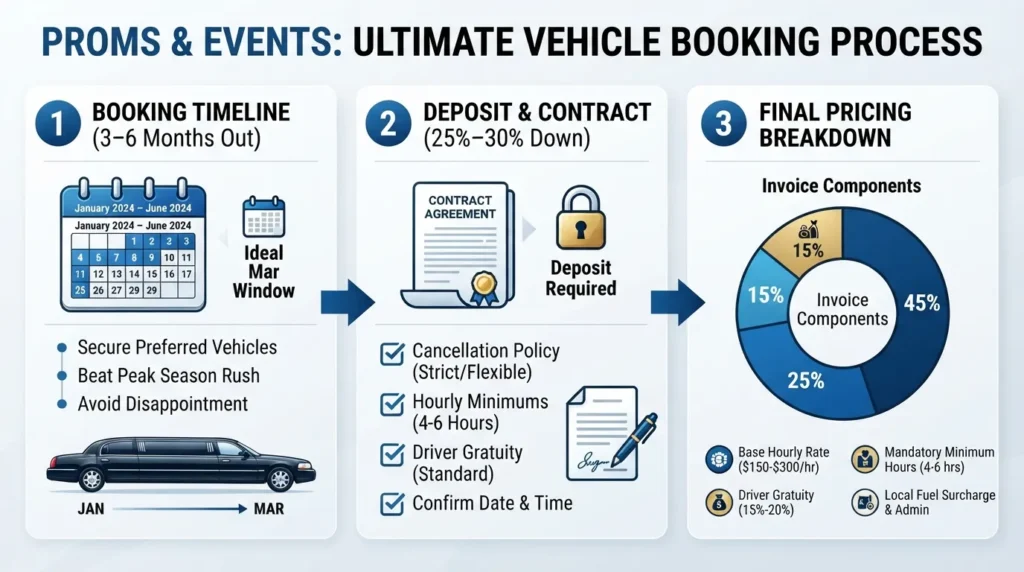
Booking a prom limousine requires early planning, a clear understanding of hourly rates, and a firm grasp of contract terms to avoid last-minute surprises. In the Toronto area and across Southern Ontario, most reputable limousine companies open their prom reservations six to eight months in advance.
1. Booking Timeline: Reserve 3 Months Early
Prom season aligns directly with wedding season and graduation party demand between April and June. You should secure your vehicle at least 3 months in advance to guarantee the exact model and passenger capacity you want. Waiting until 2–3 weeks before prom typically leaves you with limited choices, higher minimum-hour requirements, or older inventory.
2. Upfront Deposits
Once you select your vehicle, companies require a non-refundable deposit to lock in your date.
Standard Deposit: Expect to pay between 20% and 30% of the total contract cost upon signing.
Payment Method: Major credit cards are required for the deposit and to keep on file for potential incidental damages.
Balance Due: The remaining balance is usually charged 7 to 14 days prior to the prom date, though some services permit cash payment to the chauffeur upon initial pickup.
3. Hourly Pricing Structure & Package Rates
Prom rentals operate on minimum hourly packages rather than point-to-point drop-offs due to high demand.
Average Hourly Cost: A standard sedan or SUV stretch limo ranges from $150 to $250 per hour, while large party buses seat 20+ passengers and run $250 to $400+ per hour.
Minimum Hours: Prom contracts typically carry a 5- to 8-hour minimum block.
What’s Included: Base rates include the vehicle, professional chauffeur, fuel, insurance coverage, and complimentary bottled water and ice.
What’s Excluded (Extra Charges): Driver gratuity (often automatically added at 15% to 20%), highway tolls (such as the 407 ETR), extra stops not specified in the original itinerary, and cleaning fees if the vehicle requires detailed sanitation post-event.
4. Cancellation & Refund Policies
Prom bookings fall under strict seasonal cancellation terms:
Deposits: Almost universally non-refundable, as holding the vehicle prevents the company from booking it to another party during peak season.
Cancellations within 30 days: Canceling less than a month before the event often triggers a charge for 50% to 100% of the total contract balance.
Overtime Rates: If the party extends the night beyond the agreed contract end time, overtime is billed in 30- or 60-minute increments at 1.5 times the standard hourly rate. Ensure your itinerary accounts for photos, traffic, and late-night drop-offs to prevent overage charges.
Vehicle Options & Capacity
Choosing the right prom vehicle comes down to group size, comfort, and the vibe your group wants for the night. Prom transportation generally falls into three main categories: classic stretch sedans, oversized stretch SUVs, and high-capacity party buses or Sprinters.
To determine how many people fit comfortably, pay attention to the manufacturer’s maximum capacity versus practical comfort capacity. Below is a realistic breakdown of vehicle capacities, best-use cases, and interior layouts commonly available across Toronto and Greater Golden Horseshoe fleets.
| Vehicle Type | Rated Passenger Capacity | Recommended Capacity for Comfort | Ideal For |
|---|---|---|---|
| Classic Stretch Limo (Lincoln Town Car / MKT) | 6 – 10 passengers | 6 – 8 passengers | Smaller friend groups, double dates, classic aesthetic |
| Stretch SUV (Hummer H2, Escalade, Navigator) | 10 – 20 passengers | 10 – 16 passengers | Medium to large groups wanting extra legroom and headroom |
| Mercedes Sprinter / Party Bus | 12 – 28 passengers | 12 – 24 passengers | Large prom groups, standing room, full party atmosphere |
Understanding Real-World Capacity (The “Prom Dress” Factor)
While a stretch Lincoln Town Car is licensed for up to 10 passengers, fitting 10 high school students in formal wear—complete with ball gowns, suit jackets, and boutonnieres—will be a tight squeeze.
Rule of Thumb: Deduct 2 seats from the maximum advertised rating for traditional limousines, and 2 to 4 seats for large SUVs or party buses. This accounts for formal attire and ensures everyone sits comfortably without wrinkling dresses or crushing corsages.
Standard Interior Features & Amenities
Modern luxury transport vehicles function as mobile lounges designed to start the celebration safely en route to the venue. Standard features inside a dedicated prom rental include:
Custom Seating Layouts: Wrap-around leather J-seating or perimeter seating designed to let everyone talk face-to-face rather than sitting in forward-facing rows.
Audio & Tech Connectivity: High-output surround sound systems with Bluetooth, AUX inputs, or USB-C connectivity so students can play their own playlists.
Atmosphere Lighting: Fiber-optic ceiling lights, color-changing LED accent strips, and neon floor lighting controlled directly from the passenger cabin.
Non-Alcoholic Refreshment Bar: Built-in ice chests and glassware rails stocked with complimentary bottled water, sparkling cider, sodas, and ice.
Note: Professional chauffeurs inspect all multimedia and climate control systems prior to dispatch to ensure everything functions properly before pickup.
Chauffeur & Safety Standards

When parents book a prom limousine, safety and accountability matter more than leather seats or neon lighting. Professional luxury transport companies operate under strict commercial regulations to ensure teenagers arrive at and return from prom safely.
Licensing & Insurance Compliance
Commercial limousine services must carry livery insurance—typically between $2 million and $5 million in liability coverage—and hold valid local permits, such as a Toronto Vehicle-for-Hire license. Drivers are required to hold a commercial driver’s license (e.g., Class F in Ontario), pass annual background checks, and submit regular driver abstract reports to prove a clean driving record.
Zero-Tolerance Policies
Reputable fleet operators strictly enforce a zero-tolerance policy for underage drinking, drug use, smoking, and vaping inside the vehicle.
Drivers inspect the passenger cabin before departures and reserve the right to search bags.
If passengers possess illegal substances or display unsafe behavior (such as leaning out of windows or sunroofs), the driver will terminate the ride immediately.
In the event of a policy breach, the driver contacts the parent or guardian directly to pick up the student.
Parent-Facing Communication
Parents receive the chauffeur’s full name, direct cell phone number, and vehicle license plate details at least 24 to 48 hours before pickup. Modern fleets equip their vehicles with GPS tracking, allowing parents to request live location updates or receive automated SMS alerts when the limo arrives at each destination.
What Happens on Prom Night: Itinerary & Logistics
Smooth execution on prom night relies on a clear, pre-planned timeline that balances group photos, travel time, and event schedules.
Pickup Point Coordination
The driver arrives 10 to 15 minutes ahead of the scheduled pickup time at a single primary location, usually a designated parent’s house.
The chauffeur verifies the passenger headcount against the manifest.
Drivers conduct a quick safety briefing covering seatbelts, intercom use, and vehicle rules.
Collecting all passengers at one main stop saves 30 to 45 minutes of driving time compared to individual house pickups.
Photo-Stop Handling
Most groups schedule a 30- to 60-minute stop at a scenic location—such as Toronto’s High Park, Alexander Muir Gardens, or the waterfront—for photos.
The chauffeur coordinates parking in advance to avoid delays.
Drivers keep the vehicle secure and air-conditioned so students can leave personal items locked safely inside while taking pictures.
Route & Traffic Management
Experienced drivers monitor real-time traffic updates to bypass peak evening congestion and construction bottlenecks. They factor in buffer time to ensure passengers arrive at the venue entrance during peak arrival hours without rushing.
Multi-Stop & After-Prom Plans
The driver stays on standby near the venue throughout the event. For scheduled after-prom events or late-night drop-offs, the chauffeur follows the exact route agreed upon in the contract. Any changes to drop-off locations during the night require direct authorization from the primary parent contact.
Etiquette & Rules Inside the Limo

A smooth prom night relies on knowing the ground rules inside the vehicle. Limousine companies enforce strict safety regulations, and breaking them can result in immediate termination of the contract without a refund.
Key Passenger Rules & Safety Laws
Strict Passenger Capacity: Legally, every passenger must have a dedicated seatbelt. A 10-passenger stretch limousine is strictly capped at 10 riders—chauffeurs face heavy municipal fines, commercial license points, and vehicle impoundment for overloading.
Tipping Guidelines: Standard driver gratuity is 15% to 20% of the total fare. Many limousine companies automatically include an 18% gratuity on the final invoice for prom packages, so check your contract before handing over extra cash at drop-off.
Do’s and Don’ts Onboard
DO keep snacks and beverages simple: Stick to bottled water, sparkling juices, and light, non-greasy snacks.
DO stay seated while the vehicle is moving: Sit back and enjoy the ride—standing up or changing seats mid-transit increases the risk of injury during sudden stops or sharp turns.
DON’T bring alcohol, vaping products, or illegal substances: Canadian law strictly prohibits underage alcohol consumption and open alcohol containers in commercial passenger vehicles. Chauffeurs reserve the legal right to end the ride immediately and call parents for pickup if prohibited items are found.
DON’T hang out of windows or sunroofs: Never extend hands, arms, or heads out of windows or sunroofs while the vehicle is in motion.
DON’T apply unapproved decorations: Avoid confetti, silly string, tape, or glitter inside the vehicle. Professional detailing fees for glitter removal or upholstery stains range from $150 to $500 CAD.
Frequently Asked Questions
A limousine service is a specialized luxury ground transportation provider that employs professional, commercially licensed chauffeurs to transport passengers in high-end vehicles—such as stretch sedans, luxury SUVs, or party buses—on a scheduled hourly or point-to-point basis.
The term originates from the Limousin region of France, where residents wore a distinctive cloak with a raised hood. Early luxury automobiles featured an enclosed rear passenger compartment paired with a covered, open-air driver compartment that visually resembled the shape of this traditional French hood.
In the Greater Toronto Area and Canadian market, hourly rates range between $150 and $300 CAD per hour depending on vehicle type and capacity. Most companies require a mandatory 4-to-6-hour minimum package during peak prom season (May to June).
Most providers prohibit interior decorations using tape, glitter, confetti, or hanging banners to prevent damage to leather upholstery and window tinting. Magnetic exterior banners or front-grille ribbons are sometimes permitted if approved prior to the event.
Chauffeurs monitor real-time traffic updates and plan routes with built-in buffer times to keep schedules on track. If an unavoidable highway closure or major traffic delay occurs, the hourly rental clock continues to run, but drivers will communicate directly with parents or group leaders to adjust drop-off expectations.
Explore Airport Topics
Our Services
Featured Travel Guides
Industry & Safety Standards
Our Service Guarantee
Every guide is written from real chauffeur and dispatch experience — flat-rate pricing, licensed vehicles and 24/7 flight-monitored pickups across Toronto & the GTA.