Taxi Cost from Pearson Airport to Downtown Toronto: Exact Fares, Best Options & Local Tips 2026
What's the Taxi Fare from Pearson to Downtown?
Flat Rate: $60–$70 CAD
Here is the deal — a standard taxi from Pearson International Airport to downtown Toronto costs a flat rate of $60 to $70 CAD. That price already includes the $10 airport surcharge, so no surprise fees when you land. You pay what you see. No meter running, no stress about traffic on the Gardiner.
If you are looking at a VIP limo or black car service, expect to pay $75 to $95 CAD for the same route. More comfort, fixed price, professional driver — worth it for business travelers or anyone who just wants a smooth ride after a long flight.
Why the Price Varies
Toronto uses a zone-based flat rate system for airport taxis. The city is divided into geographic zones, and your fare depends on which zone your destination falls in. Downtown Toronto — think Union Station, King Street, Queen Street, the Financial District — sits in the primary zone, which locks in that $60–$70 rate. Move further out toward Midtown or North York, and the rate shifts slightly. The driver cannot charge you more than the posted zone rate. Period.
Table of Contents
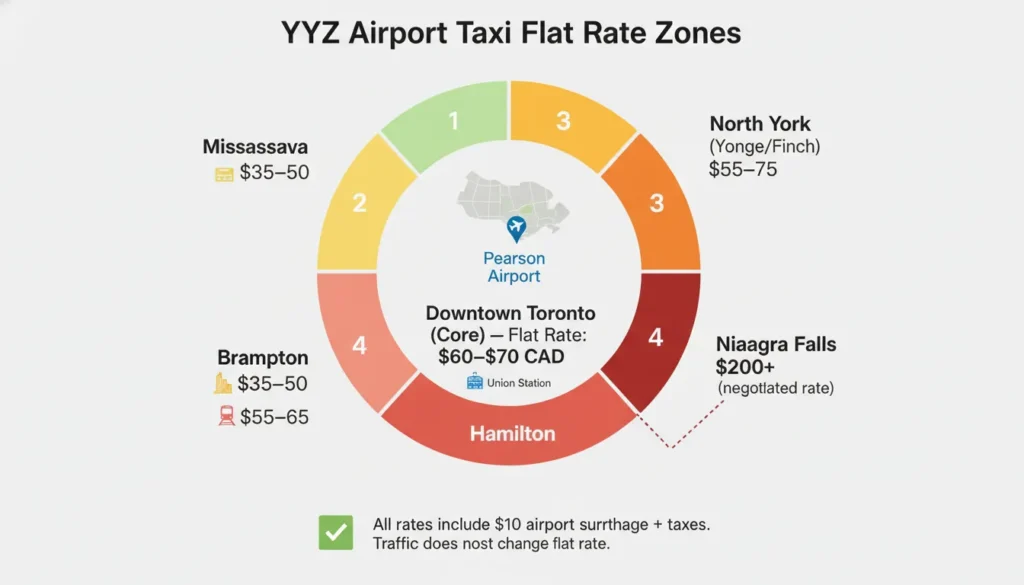
Official Flat Rate Zone Table
Downtown Core Rates
For trips to the downtown core — including the Entertainment District, Old Toronto, Harbourfront, and the area around Union Station — the flat rate sits at $60 to $70 CAD. This covers roughly a 30 to 45 minute drive depending on traffic. During peak hours, the Gardiner Expressway lanes are open in 2026, but morning and evening rush still adds 20 to 30 minutes to your trip. The flat rate stays the same regardless.
GTA Suburbs
Heading to Mississauga? You are actually closer to the airport, so rates start lower — around $35 to $50 CAD depending on the specific area. Brampton runs similar. North York trips land around $55 to $75 CAD. Always confirm the zone rate with the dispatcher before getting in the cab.
Long Distance
Long-distance trips are metered or negotiated, not flat rate. Hamilton runs approximately $120 to $150 CAD. Niagara Falls will cost you $200 or more. For these trips, a pre-booked private car service usually gives you a better deal and more reliability.
Taxi vs Uber vs Train vs Bus — Honest Side-by-Side Comparison
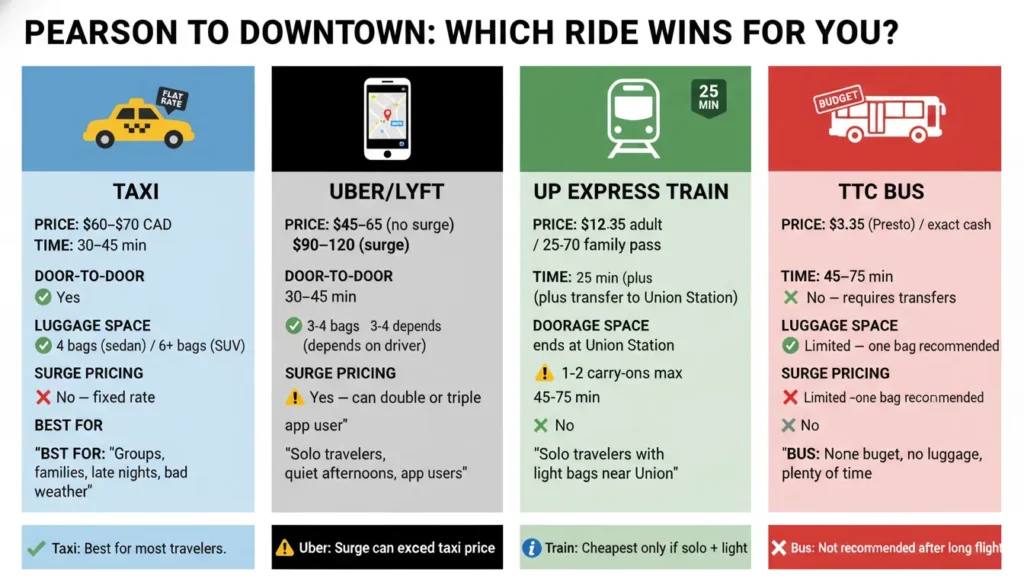
Cost Comparison Table
Standard taxi to downtown: $60–$70 CAD, flat rate, door to door. Uber or Lyft: typically $45–$65 CAD with no surge, but can spike to $90–$120 during peak times or bad weather. UP Express train: $12.35 for adults, $25.70 for a family pass — cheapest option by far if you are traveling light and alone. TTC Bus (Route 900 or 52): under $4 with a Presto card, but it takes 45 to 75 minutes and requires transfers.
When Taxi Wins Over Uber The Surge Pricing Trap
Uber looks cheap on paper until it does not. On a Friday evening, during a snowstorm, or right after a major flight lands at Terminal 1, surge pricing can push your Uber fare well past $100. A taxi flat rate never surges. If you are arriving during peak hours or bad weather, the taxi is actually the smarter financial choice — not just the convenient one.
When UP Express Makes More Sense
If you are a solo traveler with one carry-on bag, heading somewhere close to Union Station or Bloor-Yonge, the UP Express at $12.35 is a no-brainer. It runs every 15 minutes, takes 25 minutes to Union, and you skip all road traffic entirely. The problem starts when you have luggage, kids, or a destination that is not walking distance from Union Station.
TTC Bus — Who Should Actually Take It?
Honest answer: the TTC bus from Pearson is for budget travelers with time to spare and minimal luggage. It is not a bad option — it just requires patience, exact change or a Presto card, and comfort with transfers. If you are exhausted from a long international flight, this is not your ride.
Group & Family Travel: Which Option Is Actually Cheapest?
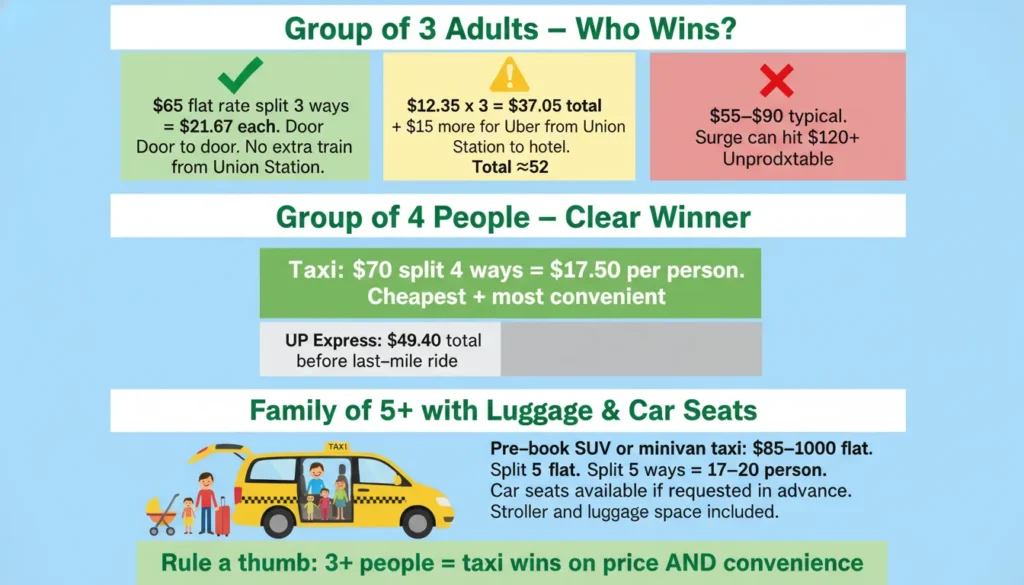
The Math for 2, 3, 4, and 5+ People
This is where taxis flip the script completely. Two people taking the UP Express pay $24.70 combined. A taxi costs $60 to $70 — still more. But with three people, UP Express hits $37.05 and a taxi split three ways is around $22 each. With four people, the taxi at $70 split four ways is just $17.50 per person. That is cheaper than the UP Express per head, and the taxi drops you at your exact door.
SUV vs Sedan vs Sprinter — Which Vehicle for Which Group Size?
A standard sedan fits four passengers comfortably with two to three mid-sized bags. For groups of five or if you have oversized luggage, request an SUV or minivan — rates are slightly higher, usually $75 to $90 for downtown. For large groups of six to eight with lots of gear, a Sprinter van is the move. Book in advance for these.
Traveling with Kids? Car Seats, Space, Luggage
If you need a car seat, you must book in advance and request it specifically — most airport taxi companies accommodate this but cannot guarantee a seat is in the vehicle if you just walk up to the taxi stand. Always call ahead. SUVs give you the most boot space for strollers, car seats, and family luggage without feeling cramped.
Late Night & Early Morning Arrivals: What Actually Works
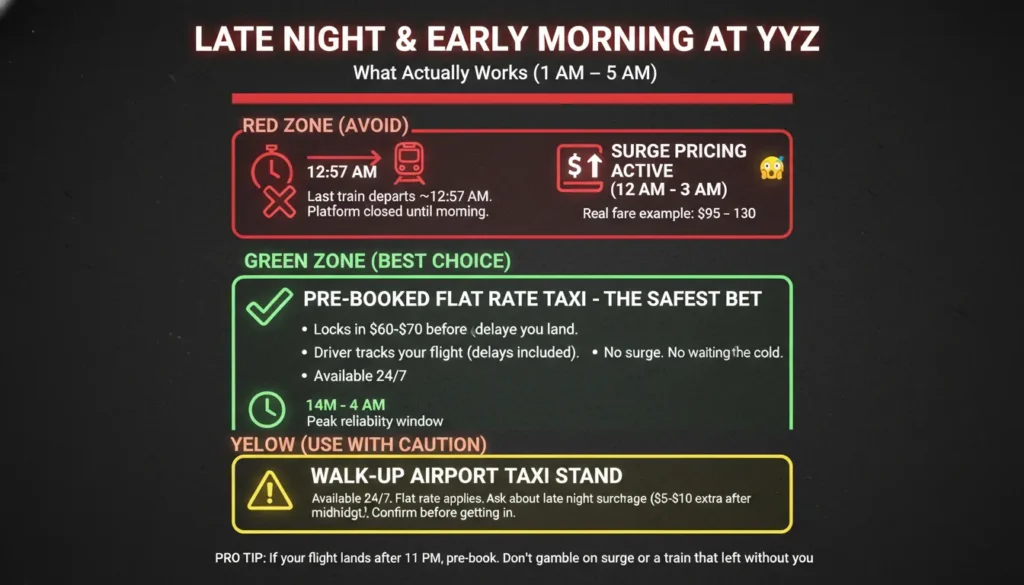
Last UP Express Train Time And What Happens After
The UP Express stops running in the late evening. Last trains to Union Station from Pearson leave around midnight. After that, it simply is not an option — the platform is closed and no one is coming.
Uber Surge After Midnight — Real Price Examples
Midnight to 3 AM is surge pricing territory for rideshare apps. Real examples from early 2026 show Uber fares hitting $95 to $130 for the Pearson-to-downtown route during these hours. That is not a deal. That is paying taxi money without the flat rate guarantee.
Why Pre-Booked Taxi is the Safest Bet for Off-Hours
A pre-booked flat rate taxi is the cleanest solution for late arrivals. You lock in the price before you land, the driver tracks your flight, and if your flight is delayed by two hours, a reputable service will wait. No surge, no guessing, no standing outside in the cold hoping an Uber is nearby.
Terminal 1 vs Terminal 3 — What's Different for Each
Where to Find the Taxi Stand at Each Terminal
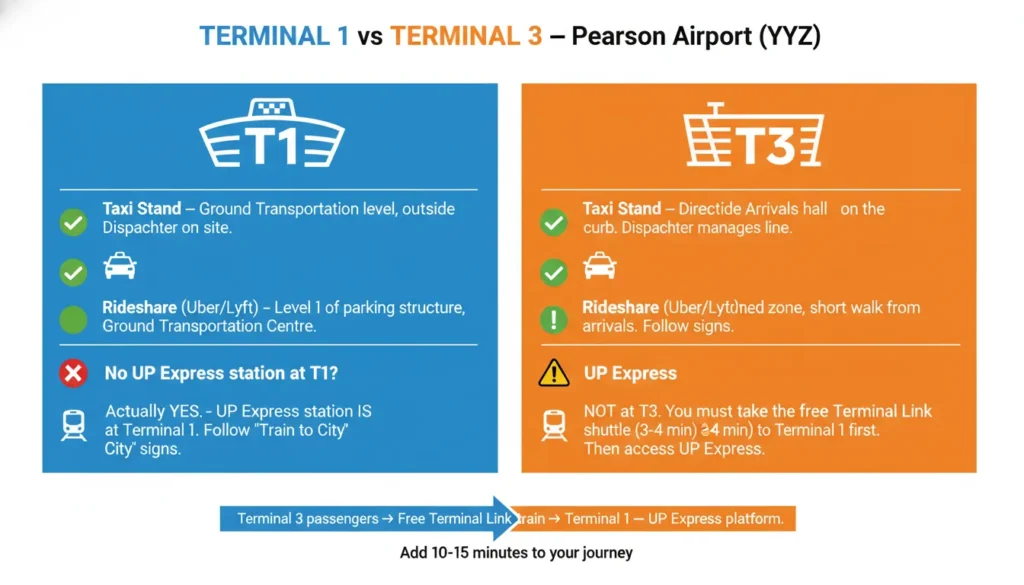
At Terminal 1, exit through the arrivals level on the Ground Transportation level and follow the signs marked “Taxi.” The official taxi stand is right outside — you will see the dispatch booth. At Terminal 3, exit the arrivals hall and look for the taxi queue on the curb directly outside. Both stands are staffed and organized — no need to wander.
Terminal 3 → Terminal 1 Transfer UP Express Users Only
If you land at Terminal 3 and want to take the UP Express, you need to catch the free Terminal Link shuttle to Terminal 1, where the UP Express station is located. This adds 10 to 15 minutes to your journey. Factor that in before you decide the train is faster.
Rideshare Pickup Zones by Terminal
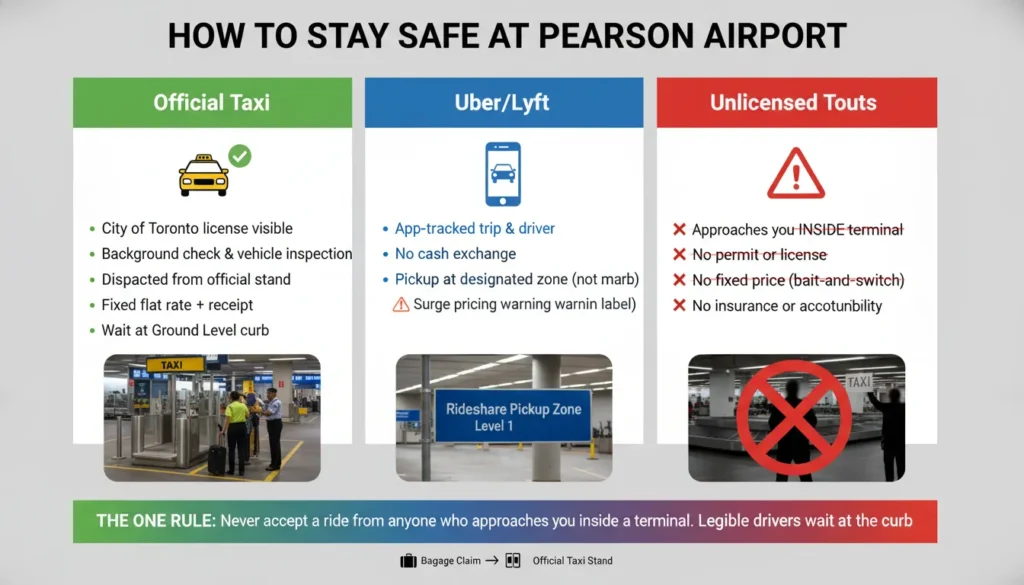
Uber and Lyft have designated pickup zones at both terminals — they are not at the main curb. At Terminal 1, rideshare pickup is on Level 1 of the parking structure (Ground Transportation Centre). At Terminal 3, follow the signs to the designated rideshare zone, which is a short walk from arrivals. Do not get in any car that approaches you inside the terminal.
Hidden Fees, Tolls & Extras — What to Watch Out For
407 ETR Toll — How to Avoid It Or Use It Smartly
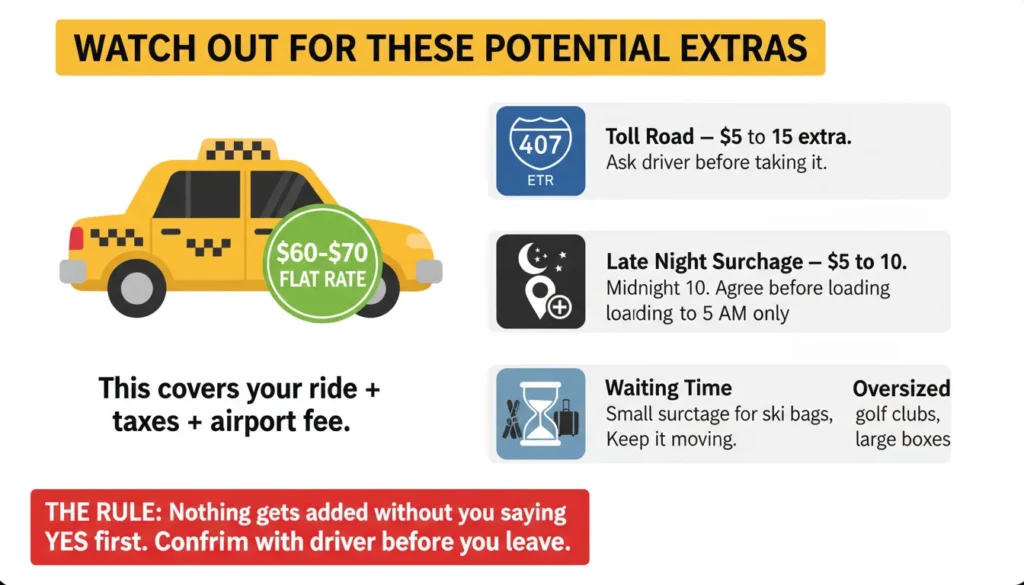
The Highway 407 is a toll road. Some taxi drivers use it to cut through traffic, and if they do, that toll can be added to your fare on top of the flat rate. Ask the driver upfront: “Are you taking the 407?” If you want to avoid extra charges, confirm you want the non-toll route. During heavy traffic, though, the 407 can save 20 to 30 minutes — sometimes worth the $5 to $15 extra.
Late Night Surcharge: Which Companies Charge It?
Some taxi companies apply a late night surcharge between midnight and 5 AM. This is usually $5 to $10 on top of the flat rate. It is legal and disclosed — but worth asking about when you book. Reputable pre-booked services will tell you the all-in price upfront.
Extra Stops, Waiting Time, Oversized Luggage Policies
Making an extra stop between the airport and your destination? Most drivers will accommodate it, but expect a small additional charge — typically $10 to $15. Waiting time, if you need the driver to hold while you grab something, is usually billed per 5-minute increment. Oversized luggage like ski bags or golf clubs may also carry a small surcharge. Ask before loading.
How to Pay: Cards, Cash, Presto — What Works Where
Airport Taxi Payment Methods
All licensed airport taxis in Toronto are required to accept credit and debit cards. Cash is always fine. Some drivers also accept tap payment. What you should not do is assume an unlicensed tout has any payment infrastructure at all — stick to the official stand.
UP Express — Presto Card vs Credit Card vs App
The UP Express accepts Presto cards (tap on, tap off), credit cards directly at the machine, and the Presto app on your phone. Adult single fare is $12.35 in 2026. The family pass at $25.70 covers two adults and up to four kids under 12 — strong value if you qualify.
TTC Bus Cash Rule The Exact Change Trap
If you are taking the TTC bus and paying cash, the driver does not make change. Exact change only. Your best move is loading a Presto card — it works on every TTC route and the UP Express, and you avoid the exact change headache entirely.
Safety: Official Taxi vs Uber vs Unlicensed Touts
How Toronto Airport Taxis Are Licensed & Vetted
Every taxi operating from Pearson Airport is licensed by the City of Toronto or the Region of Peel and must display a valid permit. Drivers go through background checks and vehicle inspections. The dispatch system at the taxi stand assigns you to the next available vetted driver — no one gets to cherry-pick passengers.
The One Rule That Protects You Inside the Terminal
Do not accept a ride from anyone who approaches you inside the terminal offering a taxi or limo. Full stop. Legitimate drivers wait at the designated curb stands. Anyone soliciting rides inside arrivals is unlicensed — no insurance, no accountability, no fixed price.
Pre-Booked Services — Extra Safety Layer Explained
When you pre-book a taxi or car service, you get the driver’s name, vehicle plate, and company contact before you arrive. If anything goes wrong, there is a paper trail. This extra layer is worth it, especially for solo travelers, late night arrivals, or anyone unfamiliar with the city.
Step-by-Step: From Baggage Claim to Your Taxi in 5 Minutes
Terminal 1 Exit Guide
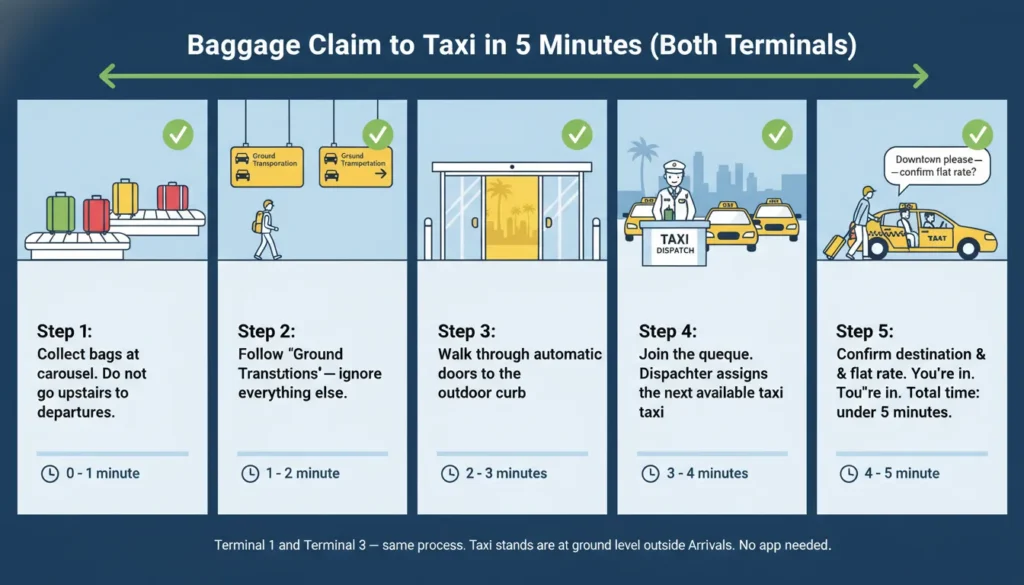
Collect your bags at the carousels on the arrivals level. Follow the signs toward Ground Transportation — do not take the elevator to departures by mistake. Walk through the automatic doors to the curb. The taxi stand is immediately to your right, staffed with a dispatcher. Give your destination, confirm the flat rate, and you are in a car within minutes.
Terminal 3 Exit Guide
Exit the baggage claim area and walk straight through the arrivals hall doors. The taxi queue is directly outside on the curb. A dispatcher manages the line. No app needed, no confusion — just join the queue.
What to Confirm with the Driver Before You Get In
Three things: confirm the destination and flat rate zone price, confirm whether they plan to use the 407 toll road, and confirm payment method if you are paying by card. Takes 30 seconds and eliminates 100% of post-trip fare disputes.
Luggage Reality Check — Train vs Taxi
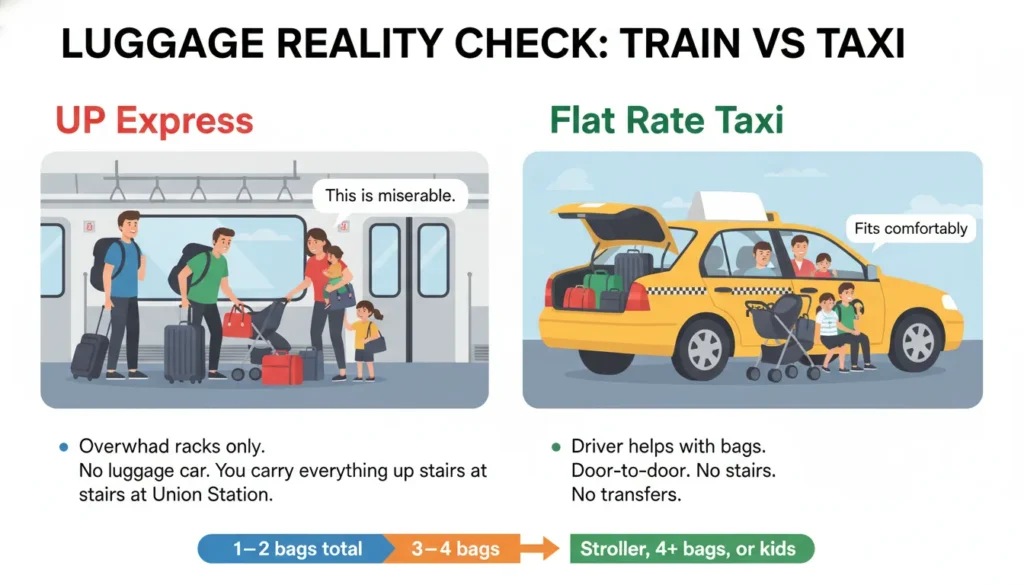
How Many Bags Can You Realistically Carry on the UP Express?
The UP Express has overhead racks and some floor space, but it is not designed for heavy luggage trips. One carry-on and one checked-size bag is manageable. Two large suitcases plus a carry-on in a busy train car is genuinely miserable, especially if you then need to transfer to the subway at Union and carry everything up stairs.
Taxi Luggage Policy Sedans vs SUVs vs Vans
A standard sedan taxi fits two large checked bags and two carry-ons in the trunk without issue. Three large bags start to get tight. For four or more large bags, book an SUV or minivan — the driver can confirm capacity when you call. You will not be left standing at the curb with bags that do not fit.
The “Total Journey” Cost Comparison Including Last-Mile
Here is something most comparison articles skip: the UP Express gets you to Union Station, not your hotel. If your hotel is in the Entertainment District or a 20-minute walk from Union, you are adding an Uber or taxi on top — call it $15 to $25 more. Suddenly the train is not $12.35, it is closer to $30 per person. For two or more people with luggage, a direct taxi to the door often wins on total cost when you do the honest math.
Frequently Asked Questions
Pearson Airport is approximately 27 kilometers from downtown Toronto. By road, that is 30 to 45 minutes without traffic, and 50 to 75 minutes during morning or evening rush hour. The UP Express covers the distance in 25 minutes because it does not share road space with cars.
Sometimes, but not always. Without surge pricing, Uber can run $45 to $60 — slightly less than the taxi flat rate. With surge pricing during peak times or bad weather, Uber regularly hits $90 to $120 on this route. The taxi flat rate of $60 to $70 is predictable. Uber is a gamble.
The official flat rate for a licensed taxi from Pearson to downtown Toronto is $60 to $70 CAD in 2026. The $10 airport surcharge is already included in that number.
No. That is the point of a flat rate. Whether you sit in Gardiner traffic for an hour or sail through at 2 AM, the price does not change. You pay the zone rate regardless of how long the trip takes.
Yes, and for late night arrivals or families with lots of luggage, it is strongly recommended. Several licensed companies offer pre-booking with flight tracking so your driver adjusts automatically if your flight is delayed.
If you pre-booked, the company tracks your flight and adjusts pickup time automatically. If you are using the taxi stand on arrival, delays do not matter — you simply join the queue when you land, regardless of what time it is.
Tipping is not mandatory but it is standard. Most passengers tip 10 to 15 percent. For a $65 fare, $7 to $10 is a reasonable tip. If the driver helped with heavy bags or navigated well, tip on the higher end.
Beck Taxi and Crown Taxi are among the most established licensed operators at Pearson with strong reputations. For pre-booked flat-rate service, several private car companies serve the airport route with professional drivers and confirmed pricing.
Which Option Should You Choose?
Decision Tree Based on Group Size, Time, Budget
Solo traveler, one bag, heading near Union Station, daytime arrival: take the UP Express at $12.35 and save your money. Solo or couple, moderate luggage, flexible budget, or arriving at night: take a flat-rate taxi at $60 to $70 and enjoy the door-to-door convenience. Group of three or four, multiple bags, any time of day: split a taxi — it becomes the cheapest per-person option and the most convenient. Family with kids, car seats, or strollers: pre-book an SUV taxi, confirm the car seat, and do not stress the airport chaos. Late night arrival, any group size: pre-booked flat-rate taxi, full stop. Do not rely on Uber surge or a train that stopped running.
The $60 to $70 flat rate taxi from Pearson to downtown Toronto is not the cheapest option on the list — but it is the most reliable, the most direct, and the best value the moment you add a second person, a few bags, or an inconvenient arrival time. Know your options, do the math for your specific situation, and pick the one that fits. That is the whole game.
RELATED READS
You Might Also Find This Useful
Explore Airport Topics
Our Services
Featured Travel Guides
How Much to Tip an Airport Limo Driver in Toronto
Child Car Seat Limo Service Toronto
Clean Limo Service Toronto — Sanitized Rides
How to Avoid Security Lines at Pearson Airport
SUV vs Sedan — Airport Luggage Capacity
Corporate Duty of Care for Business Travel Toronto
View All Travel Guides →Industry & Safety Standards
Our Service Guarantee
Every guide is written from real chauffeur and dispatch experience — flat-rate pricing, licensed vehicles and 24/7 flight-monitored pickups across Toronto & the GTA.
24/7 Quick Response
+1 (647) 654-4915